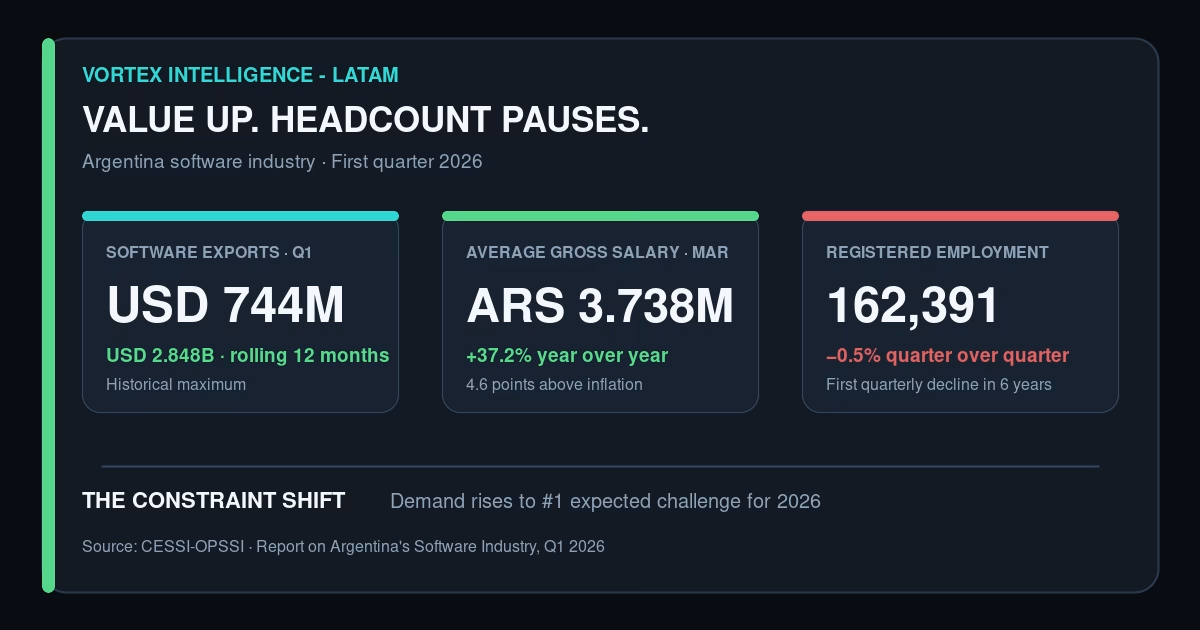
A first quarterly employment decline in six years sits beside record exports, real wage gains, and optimistic sales forecasts. The contradiction is the signal: Argentina’s software industry is entering a more selective phase of growth.
Executive briefing
Argentina’s software industry reached 162,391 registered jobs in the first quarter of 2026, but employment fell by 849 positions from the previous quarter. The 0.5% decline was small, yet historically significant: it was the sector’s first quarterly contraction in six years.
That would normally read as a cooling story. The rest of the data says something more complicated.
The latest CESSI-OPSSI sector report says software exports reached USD 744 million in the first quarter and a record USD 2.848 billion over the preceding 12 months, 11.4% above the comparable period. Average registered-sector pay reached ARS 3.738 million in March, up 37.2% year over year against 32.6% inflation. Nearly three quarters of surveyed companies expected higher sales in 2026.
The useful conclusion is not that the software boom has ended. It is that revenue, exports, salaries, and headcount are no longer moving in lockstep. For founders, investors, policymakers, and technology leaders, that divergence matters more than the headline job loss.
Four numbers define the inflection point
The public report, produced by the software industry chamber’s OPSSI observatory, combines public employment, salary, and balance-of-payments data with a sector survey. Four figures capture the current state.
First, registered employment stood at 162,391 in the first quarter, down 0.5% from late 2025. The report places that decline alongside a 0.3% quarterly contraction across registered private-sector employment. Software therefore weakened slightly more than the broad formal labor market during the quarter, but remained one of Argentina’s strongest long-run job creators: it added more than 65,000 registered positions over ten years.
Second, software generated USD 744 million in exports during the quarter. On a rolling 12-month basis, exports reached a historical maximum of USD 2.848 billion. CESSI calculates that software export revenue grew 13.8% in 2025 and more than doubled over the decade. That sits inside a wider national export base: Argentina’s government reported that knowledge-economy service exports reached a record USD 9.6 billion in 2025, or 53% of the country’s total service exports. The official announcement attributes those figures to INDEC.
Third, the average gross salary for registered software workers reached ARS 3.738 million in March 2026. It rose 13.4% from December and 37.2% year over year, 4.6 percentage points above the reported inflation rate. CESSI estimates that the figure was 110% higher than the economy-wide registered-worker average. The report also says real purchasing power rose 3.6% in the first quarter.
Fourth, 73% of surveyed companies expected unit sales to grow during 2026, while only 6% expected a decline. Confidence about sales therefore coexists with a near-term reduction in employment.
Why stronger exports do not guarantee more hiring
Export growth can raise sector revenue without producing proportional local headcount growth. Several mechanisms can create that separation.
Companies may be selling higher-value work, improving utilization, automating delivery, consolidating teams, shifting the mix toward products and platforms, or postponing hiring until demand becomes clearer. Exchange-rate and pricing changes can also alter the relationship between foreign revenue and domestic payroll.
The data does not isolate each mechanism’s contribution. It would be irresponsible to declare the 849-position decline an “AI job loss” without employer-level evidence. What the report does establish is a change in the industry’s constraint structure.
Historically, qualified labor availability was the sector’s dominant growth problem. In the 2025 ranking it fell to fifth place. Salary cost remained the largest concern, while insufficient demand moved from ninth place in 2024 to second in 2025 and became the top concern companies expected for 2026.
That transition is important. A sector organized around a talent shortage behaves differently from one organized around demand quality and margins. In the former, the central challenge is recruiting enough people. In the latter, companies become more selective about projects, pricing, utilization, product-market fit, and which skills justify premium compensation.
The labor market is becoming more selective, not cheap
The simultaneous salary increase and employment dip rejects a simplistic interpretation that companies are solving pressure by lowering the price of labor.
The average salary rose faster than inflation even as headcount declined. Staff turnover also remained close to its recent level: OPSSI measured 6.4% for the first four months of 2026, an annualized rate of roughly 20%. That is far below the extraordinary 40% turnover recorded in 2021 and broadly consistent with the previous three years.
This combination points toward retention and selection. Experienced workers who map directly to export revenue, client ownership, security, data, product, and automation can remain expensive even when companies reduce marginal hiring. Entry routes may become harder at the same time that established specialists preserve or improve their real income.
For employers, the risk is hollowing out the future talent pipeline. If every company responds to uncertainty by demanding senior productivity without financing junior development, the sector can recreate its old talent shortage later with a weaker bench.
For workers, the signal is equally direct: belonging to “tech” is becoming less useful than demonstrating a measurable connection to revenue, product performance, operational leverage, or risk reduction.
Remote work remains part of the export model
The report also shows that Argentina’s software labor market has not returned to a conventional office baseline.
In January 2026, 38% of surveyed companies were fully remote and another 41% required only one or two office days per week. That leaves 79% operating in fully or mostly remote modes. However, the share requiring three or four office days rose from 9% to 17% in one year, while fully on-site work increased from 3% to 5%.
This is not a full reversal. It is a widening split between companies that treat geographic flexibility as part of their operating model and those rebuilding office-centered coordination. For an export sector whose largest foreign market is the United States, remote capability remains more than an employee benefit. It is delivery infrastructure.
The strategic question is whether hybrid tightening improves execution enough to justify shrinking the national talent pool available to each employer. Firms that can measure the answer by team and workflow will have an advantage over those applying a symbolic attendance rule.
What leaders should do now
Software companies should separate headcount planning from revenue optimism. A sales forecast does not specify which work will scale, what margin it carries, or whether delivery needs more people. Plans should model revenue per employee, utilization, automation gains, customer concentration, skill bottlenecks, and the lag between junior hiring and productive capacity.
Boards and investors should ask whether export growth is broad or concentrated. The United States represented 49.1% of sector export revenue in 2025, according to OPSSI. That market depth is valuable, but it creates exposure to U.S. demand cycles, procurement behavior, and currency or policy shifts. Mexico, Uruguay, Chile, Spain, and other destinations provide a diversification path that should be measured rather than merely celebrated.
Talent leaders should protect apprenticeship capacity. A short hiring pause can be rational; a prolonged collapse in junior intake transfers training costs to competitors and eventually tightens supply for everyone. Shared programs across companies, universities, clusters, and regional technology poles can reduce that coordination problem.
Policymakers should avoid treating one negative quarter as a case for indiscriminate subsidy. The sector is still exporting at record levels and expects sales growth. More useful interventions would reduce the friction around first employment, skills conversion, international sales, financing, and access to new markets while publishing better data on occupations, seniority, company size, and regional distribution.
The strategic reading
Argentina’s software sector is not showing a clean boom or a clean bust. It is showing a maturity test.
Exports are at a record. Salaries are gaining real value. Most firms expect to sell more. Yet employment has declined for the first time in six years, salary cost remains the largest current problem, and demand has become the leading expected constraint.
The inference is that the next phase will reward companies that convert scarce talent into differentiated, exportable value—not those that simply maximize headcount. That can produce a stronger industry, but only if productivity gains coexist with entry paths, market diversification, and the patient construction of future skills.
One quarter does not establish a trend. It does establish the question that every subsequent quarter must answer: can Argentina keep increasing the value of its software exports without allowing a temporary hiring pause to become a structural narrowing of opportunity?
What to watch next
- Whether registered software employment rebounds in the second and third quarters or confirms a longer contraction.
- Whether export revenue continues rising faster than headcount and what that implies for revenue per worker.
- Whether demand remains the industry’s leading constraint as inflation recedes in company rankings.
- Whether junior and trainee hiring diverges from senior and client-facing technical roles.
- Whether the move toward more office days affects retention, geographic diversity, and export delivery.
- Whether Mexico, Chile, Uruguay, and other destinations reduce dependence on the United States.
Sources
- CESSI-OPSSI: Report on Argentina’s Software Industry, First Quarter 2026
- CESSI: OPSSI observatory and report archive
- Argentina.gob.ar: Knowledge-economy service exports reached a record in 2025
- INDEC: Balance of payments, international investment position and external debt
- INDEC: Consumer Price Index, March 2026