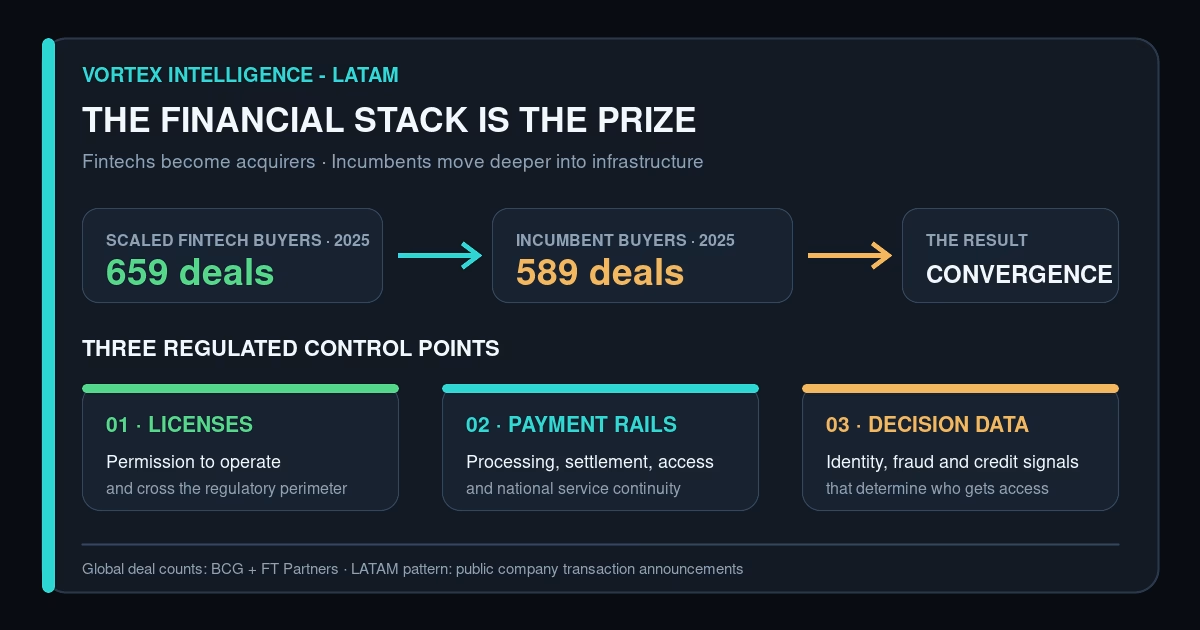
Scaled fintechs have moved from acquisition targets to consolidators. In Latin America, the more important contest is not fintech versus bank; it is who controls licenses, payment rails, credit data, and the customer relationship.
Executive briefing
The balance of power in financial technology is changing. Boston Consulting Group and FT Partners count 659 acquisitions of fintech targets by scaled fintech companies in 2025, compared with 589 by incumbent acquirers. A year earlier, incumbents led 517 to 491. The reversal does not mean banks have stopped buying technology. It means mature fintechs now have enough capital, distribution, and regulatory competence to use acquisitions as an operating strategy.
Latin America makes the shift unusually visible. Nubank has agreed to acquire a Brazilian bank to add a banking license. Visa completed the acquisition of Argentine processing and payment-infrastructure companies. Equifax agreed to buy a Mexican credit bureau with alternative-data assets and a large lender network. These deals move in different directions, but they point to the same prize: control of the regulated infrastructure beneath financial products.
The next phase of regional fintech will therefore be less about launching another app and more about assembling a financial stack.
The global reversal is real—but the definition matters
The BCG and FT Partners 2026 fintech report provides the clearest evidence of the change. Its 659-to-589 result counts deals in which the target was a fintech and separates scaled fintech acquirers from incumbent strategic buyers and financial buyers. It excludes joint ventures and management buyouts. That scope is important: this is not a count of every bank merger or every technology acquisition in the economy.
Within that boundary, the direction is unambiguous. Scaled fintechs were the most active acquirer class in 2025. The report argues that acquisition is becoming a way to fill capability gaps, enter markets, absorb subscale competitors, and acquire products or talent faster than building internally.
J.P. Morgan’s 2026 fintech sector report reaches a compatible conclusion from a narrower US venture-backed dataset: nearly half of fintech buyers in 2025 were other startups. It also describes record acquisition activity and a return of billion-dollar transactions. The underlying PitchBook data has its own limitations, including disclosed-value filters for some charts and a note that it was not reviewed by PitchBook analysts.
Those caveats do not invalidate the signal. They prevent a catchy statistic from becoming a universal law. Fintechs have become serious buyers, while incumbents, networks, data companies, and private capital remain powerful consolidators.
LATAM deals reveal the three control points
Three recent transactions show what buyers are actually seeking in the region.
The first control point is regulatory permission. In July, Nubank announced an agreement to acquire Banco Porto Real, subject to approval by Brazil’s Central Bank. Nubank says the bank’s license will join its existing payment-institution, finance-company, and securities-brokerage licenses. The company presents the transaction as a way to comply with rules governing which institutions may use banking terminology, while leaving its app, products, brand, and customer experience unchanged.
This is acquisition as regulatory architecture. The target’s wholesale-credit business matters, but the license is the strategic bridge. A digital financial institution is buying a legal capability that would be slower or less certain to reproduce from scratch.
The second control point is transaction infrastructure. In February, Visa completed its acquisition of Prisma and Newpay in Argentina. Prisma provides card-issuer processing. Newpay operates real-time payment services, the Banelco ATM network, and PagoMisCuentas. Visa says the combined platform will support tokenization, biometric authentication, risk tools, and agentic-commerce capabilities while retaining multi-brand and multi-method processing.
This is not merely a portfolio expansion. Processing, ATM access, bill payment, authentication, and risk are high-leverage positions in the national payment system. Whoever operates those layers influences cost, resilience, product speed, and the practical neutrality available to banks and fintechs that depend on them.
The third control point is decision data. In July, Equifax agreed to acquire Círculo de Crédito in Mexico for an enterprise value of USD 750 million, subject to regulatory approval. Equifax says the bureau serves more than 1,700 customers across banking, retail, fintech, microfinance, telecom, and small-business lending, with two billion tradelines covering 80 million validated identities. It also highlights alternative data from utilities, telecommunications, and gig-economy activity.
In a market where many people have thin or nonexistent traditional credit files, data coverage is not a back-office asset. It shapes who can be scored, offered credit, priced, or rejected. Acquiring that layer can create inclusion opportunities, but it also concentrates governance responsibility.
The power shift runs both ways
These transactions resist a simple disruption narrative.
Nubank is a fintech buying a bank. Visa is a global network buying regional payment infrastructure. Equifax is a data incumbent buying a Mexican financial-information platform. Each buyer is moving toward a regulated control point, but the buyers come from different institutional families.
That is why “fintechs now buy more than banks” is only the opening observation. The stronger thesis is that the boundaries between fintech, bank, network, processor, and data provider are collapsing. The winners are building combinations of product distribution, licensing, balance-sheet access, payment execution, identity, fraud control, and decision data.
For Latin America, this consolidation has a geographic dimension. Regional scale is difficult because licenses, payment methods, credit data, and consumer behavior remain local. Buying a proven control point can be faster than exporting a standardized platform and discovering that the market’s institutional plumbing does not travel.
What can go wrong
Acquisition does not automatically create an integrated stack.
Technology integration is the first failure mode. Payment and credit systems carry long operational histories, specialized rules, and dependencies that cannot be replaced like a consumer front end. A rushed migration can turn strategic control into reliability risk.
Regulatory approval is the second. Several announced transactions remain subject to competition or financial-authority review. Regulators will need to consider not only ownership but also neutrality, data use, interoperability, service continuity, and the bargaining power of downstream institutions.
Data governance is the third. Combining alternative data, identity signals, transaction history, and automated decisioning can improve fraud detection and credit access. It can also produce opaque exclusion, purpose creep, and a larger breach surface. The strategic value of the dataset raises the cost of governing it badly.
Finally, the acquisition price can outrun the operating value. A license, rail, or dataset is not valuable in isolation; it must improve economics, distribution, or product capability without destroying trust or creating unmanageable integration debt.
What leaders should watch
For CIOs and CISOs, the key question is where operational accountability lands after the transaction. Boards should require explicit ownership for migration, resilience, identity, fraud, data lineage, model governance, and incident response before platforms are combined.
For fintech founders, exit strategy is becoming more diverse. A credible buyer may be another fintech seeking a license or capability, not only a bank or private-equity fund. That increases optionality, but it also rewards assets that are difficult to reproduce: regulatory standing, trusted distribution, proprietary data rights, resilient rails, and proven compliance operations.
For investors, deal counts are less useful than control-point quality. A small acquisition that unlocks a banking license or national payment connection can be more strategic than a larger purchase of overlapping software.
For regulators, the test is whether consolidation improves infrastructure without making access dependent on a single vertically integrated owner. Interoperability, non-discrimination, portability, and continuity planning should be treated as transaction design questions, not post-merger cleanup.
Fintechs becoming acquirers is a maturity signal. In Latin America, it is also a map of where power is moving. The decisive companies will not merely own the most visible app. They will control—or remain credibly connected to—the licenses, rails, and data that make the app possible.