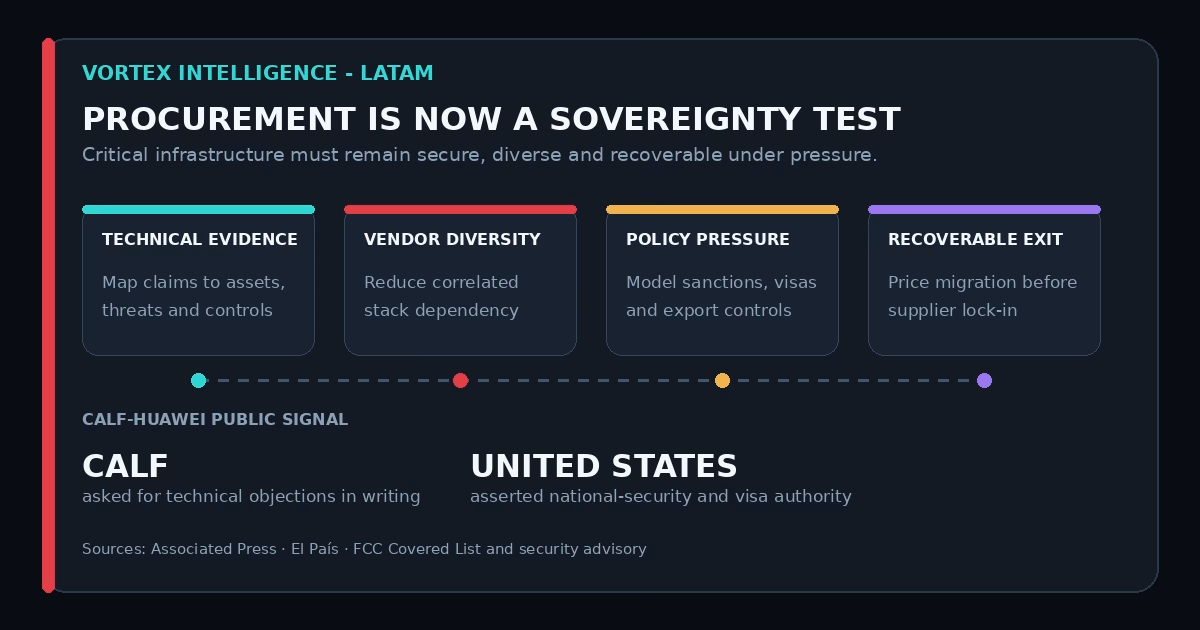
Argentina’s dispute over Huawei equipment shows why critical-infrastructure buyers need a procurement model that can test technical risk, geopolitical coercion, vendor concentration, and exit cost at the same time.
Executive briefing
A procurement dispute in Neuquén has become a compact preview of the choices that Latin American infrastructure operators will face more often. CALF, an electricity and connectivity cooperative, says a U.S. diplomat warned that executives could lose or be denied U.S. visas if the organization expanded work with Huawei. The U.S. ambassador later defended visa decisions as a sovereign security tool, while China’s embassy framed the pressure as interference with Argentina’s sovereignty and the free market.
The public record does not settle whether Huawei is the right supplier for CALF. It exposes a more important governance gap: a conventional tender can compare price, specifications, delivery, and support, but it is poorly equipped to price state pressure, intelligence concerns, sanctions exposure, forced migration, or dependence on a single geopolitical bloc.
The durable response is not to declare one country’s vendors safe and another’s unsafe. It is to make critical-technology procurement evidence-based, multi-vendor where practical, and reversible by design. Security claims should arrive in writing and map to specific assets and controls. Commercial offers should disclose lifecycle dependencies. Executives should know what it would cost to isolate, replace, or operate through a geopolitical rupture before signing.
What the public evidence establishes
Associated Press reported that CALF alleged its executives had been threatened with U.S. visa revocation over negotiations with Huawei. AP also reported that Ambassador Peter Lamelas requested a meeting, offered help evaluating U.S. alternatives, and confirmed that WhatsApp messages sent to a CALF manager reflected official policy.
El País described the project as connectivity and data-center infrastructure in Neuquén and reported CALF’s request for written technical objections. The cooperative said it operates a multi-vendor network and distinguished a state’s authority over its visas from invoking that authority informally to influence an Argentine organization’s project.
The U.S. security position is not invented for this dispute. The FCC’s June 2026 Covered List includes Huawei telecommunications equipment and services. A separate FCC national-security advisory urges buyers to consider surveillance, disruption, and interconnection risks associated with listed equipment.
Those documents explain Washington’s risk model, but they do not automatically answer CALF’s engineering question. A U.S. domestic restriction is evidence of a government risk judgment; it is not a substitute for an asset-specific threat model, architecture review, migration plan, or Argentine legal decision.
That distinction matters. If governments want foreign buyers to change suppliers, the strongest case is a documented one: identify the exposed function, plausible attack path, required mitigation, residual risk, and acceptable alternatives. Pressure without that technical bridge can harden political resistance while leaving the buyer no better prepared to secure the system.
Critical procurement now has four simultaneous risk planes
1. Technical compromise
The familiar question is whether equipment, software, updates, remote administration, or support channels could enable unauthorized access or disruption. Buyers should test secure boot, signed updates, vulnerability handling, access logging, network segmentation, data flows, management-plane exposure, and the ability to operate when remote support is unavailable.
This work must reach beyond a vendor questionnaire. Independent testing, contractually enforceable disclosure, component inventories, incident-notification duties, and a right to audit are more useful than generic assurances from either a supplier or a foreign government.
2. Supplier and jurisdiction dependency
A technically sound component can still create strategic fragility if only one vendor can maintain it, if replacement parts depend on export approval, or if software licenses can be interrupted by sanctions. The relevant dependency map includes the manufacturer, cloud and identity services, integrators, distributors, update infrastructure, cryptographic roots, and specialist labor.
The European Commission’s 5G Toolbox implementation statement combines supplier-risk restrictions with vendor diversification. That pairing is important: exclusion without a diversity plan may simply exchange one concentration risk for another.
3. Coercion and policy volatility
Visa pressure makes an often-hidden risk visible. States can influence procurement through export controls, finance, sanctions, licensing, intelligence sharing, diplomatic access, and personal mobility. None of those tools appears in a router’s specification sheet, yet each can change a project’s economics or leadership incentives.
A board should therefore ask which decisions could be altered by action from the supplier’s home state, the buyer’s allies, or countries controlling critical components. The answer belongs in the enterprise risk register, not in informal conversations with individual managers.
4. Exit and continuity cost
The most neglected procurement metric is recoverability. If a supplier becomes prohibited, compromised, insolvent, or politically unacceptable, can the operator preserve service while migrating?
The ENISA baseline for secure ICT procurement recommends lifecycle-oriented security requirements rather than a one-time product check. Contracts should cover configuration export, data portability, documentation, escrow where appropriate, interface standards, transition assistance, spare capacity, patch obligations, and secure end-of-life handling.
Exit cost is not a reason to avoid sophisticated infrastructure. It is a price that should be estimated before lock-in, when the buyer still has leverage.
A procurement model Latin American operators can use
The CALF dispute suggests a practical decision gate for telecom, energy, water, transport, financial, and public-sector systems.
First, classify the asset. A public website, an office switch, a network core, a data-center management plane, and a grid-control environment do not deserve the same geopolitical threshold. Criticality should reflect service impact, data sensitivity, remote-control capability, and recovery time.
Second, require claim-to-control traceability. Any party asserting that a supplier presents a security risk should identify the technical or legal basis and the controls that would reduce it. Classified evidence may limit disclosure, but the buyer still needs a usable risk statement rather than a nationality label.
Third, score concentration across the full stack. A nominally multi-vendor network can remain dependent on one management system, integrator, cloud service, chipset family, or update channel. Diversity should reduce correlated failure, not decorate the architecture diagram.
Fourth, price a forced-exit scenario. Estimate the time, capital, service interruption, contract penalties, retraining, and security exposure involved in replacing the supplier under pressure. Run that scenario for every major geopolitical bloc represented in the design.
Fifth, protect decision integrity. Material government communications should enter formal governance channels, be logged, and reach legal, security, engineering, procurement, and board risk owners. Informal pressure on an employee is a poor control surface for either national security or corporate governance.
Finally, publish the decision criteria where public accountability applies. Operators do not need to expose sensitive architecture, but they can state how they balance security evidence, interoperability, cost, resilience, jurisdiction, and continuity. Transparency makes it harder for procurement to be captured by either vendor lobbying or opaque geopolitical leverage.
The strategic lesson
The Huawei question will not be resolved by pretending geopolitics is absent from technology, nor by allowing geopolitics to replace engineering. Latin American operators need both lenses.
The OECD’s work on digital security for critical activities treats energy, communications, banking, transport, and other essential services as risk-management problems involving public and private actors. That is the right altitude for this dispute. Supplier selection is not merely a purchase; it allocates operational dependence across companies, jurisdictions, and future political conditions.
CALF’s request for written technical objections is therefore more than a defensive gesture. It points toward the governance standard the region needs: make security claims testable, make dependencies visible, and make architectures survivable when today’s political alignment changes.
What to watch next
- Whether CALF and the U.S. Embassy publish technical criteria or only political positions after their meeting.
- Whether Argentina develops a transparent supplier-risk framework for critical digital infrastructure.
- Whether alternative offers are evaluated on interoperability and exit cost, not only country of origin.
- Whether regional utilities and cooperatives add geopolitical continuity scenarios to procurement and board risk reviews.
- Whether multi-vendor designs reduce real control-plane dependency or merely mix hardware brands.
Sources
- Associated Press: China rebukes US over Huawei dispute as Argentina’s Milei balances ties with Washington and Beijing
- El País: Estados Unidos amenaza con retirarles la visa a empresarios argentinos si contratan a Huawei
- FCC: Covered List, June 12, 2026
- FCC: National Security Advisory on Covered Equipment and Services
- European Commission: Implementation of the 5G Cybersecurity Toolbox
- ENISA: Baseline Security Requirements for Secure ICT Procurement
- OECD: Building Stronger Defences for a Digital Future