IBM’s acquisition of Confluent makes a larger architectural point visible: an agent cannot act safely on yesterday’s snapshot when the business has already changed.
Enterprise AI has spent several years learning how to retrieve documents, summarize records, and answer questions over data at rest. The next phase is less comfortable. Agents are being asked to notice an event, understand its business meaning, choose an action, and touch an operational system while the event is still relevant.
That shift changes the data problem. A nightly warehouse load may be adequate for a management dashboard. It is a dangerous clock for an agent deciding whether a payment looks fraudulent, whether inventory can be promised, whether an industrial alarm needs escalation, or whether a customer is eligible for a real-time offer.
IBM’s completed acquisition of Confluent is important because it puts event streaming near the center of an enterprise AI portfolio. The transaction does not prove that one vendor stack is the answer. It does confirm that the contest around agentic AI is moving below the model layer, toward the infrastructure that delivers live, governed context.
For Latin American technology leaders, the practical question is no longer only which model to use. It is whether the organization has an event backbone trustworthy enough to tell an agent what is true now.
What IBM actually bought
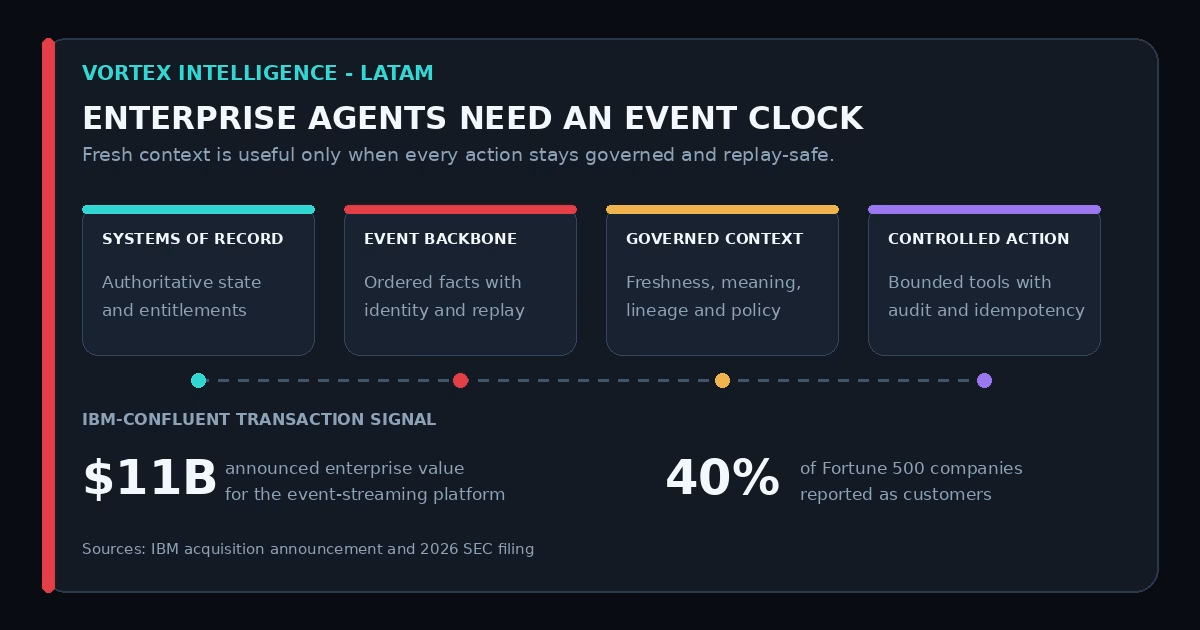
IBM completed the Confluent acquisition on March 17, 2026. The announced enterprise value was about $11 billion. IBM said Confluent served more than 6,500 enterprises, including 40% of the Fortune 500, and identified immediate integration points with watsonx.data, IBM MQ, webMethods Hybrid Integration, and IBM Z.
The closing is not merely a vendor press-release claim. IBM’s second-quarter filing with the U.S. Securities and Exchange Commission records the March 17 completion, the purchase-price allocation, and Confluent’s integration into IBM’s Software segment. The filing describes the strategic combination as trusted communication and data flow across environments, applications, and APIs for generative and agentic AI.
The price buys more than Kafka hosting. Confluent’s platform combines event transport, connectors, stream processing, schemas, governance, and the operational machinery needed to run data in motion. IBM is connecting that layer to systems where many enterprises still keep their most consequential records: mainframes, transaction processors, integration middleware, databases, and hybrid-cloud applications.
That matters because an enterprise agent has two very different data needs. It needs durable knowledge: policies, contracts, product definitions, customer history, and documentation. It also needs a current event clock: a payment just cleared, a shipment was delayed, a device changed state, a balance crossed a threshold, or another system already completed the action.
A vector index can help with the first need. It cannot, by itself, solve the second.
Data at rest is not operational truth
Most enterprise AI architectures begin with retrieval. Documents and database records are copied, indexed, embedded, and made available to a model. This is useful, but the copy creates a time boundary. The answer is only as current as the last successful synchronization.
An agent that merely drafts a summary can tolerate some staleness. An agent that changes a price, releases an order, blocks an account, or opens an incident cannot. Between retrieval and action, the underlying state may change again.
Event streaming provides a different primitive: an ordered record of business facts as they occur. The Apache Kafka documentation describes a distributed event-streaming model in which producers publish events, consumers process them independently, and retained records can be replayed. Stream processors such as Apache Flink can enrich, correlate, aggregate, and evaluate those events continuously.
This does not magically make an AI agent correct. It gives the architecture a better clock and a recoverable history.
The useful pattern has four layers:
1. Systems of record remain authoritative for balances, orders, identities, assets, and entitlements. 2. An event backbone publishes material changes with stable identifiers, timestamps, schemas, and replay. 3. A governed context layer adds business meaning, lineage, access policy, and freshness information. 4. Agents and applications observe that context, but execute through explicit tools with authorization, idempotency, limits, and audit trails.
IBM’s localized Confluent announcement for Mexico frames the acquisition around continuously flowing operational signals. Its Think 2026 real-time context architecture goes further, describing event streams transformed into structured context for agents and applications, with semantics and governance attached.
Those are vendor claims about IBM’s product direction, not independent performance results. The architectural distinction is still valid: live events need meaning and policy before they become safe agent context.
The control problem gets harder in real time
Fresh data can make an agent more useful. It can also help it make a bad decision faster.
Real-time context therefore needs stricter controls than a conversational assistant. Every event should answer basic questions: who produced it, which entity it concerns, what schema version applies, when it occurred, whether it supersedes another event, and how long it remains decision-relevant. Every action should carry a correlation ID and an idempotency key so a replayed event does not produce a duplicate transfer, ticket, message, or order.
The agent also needs a bounded decision window. If fraud evidence is incomplete, the permitted action may be to pause and escalate, not permanently block. If an inventory event is older than a defined threshold, the agent may be required to query the authoritative system again. If two sources disagree, policy should decide which system wins rather than leaving the model to improvise.
Five controls deserve particular attention:
- Freshness contracts: define the maximum age of each input for each decision.
- Schema and semantic ownership: assign teams to the meaning of events, not only the uptime of pipelines.
- Action idempotency: make retries safe and duplicates observable.
- Human escalation: preserve an explicit path for ambiguity, high consequence, and policy conflict.
- Replay testing: prove that reprocessing historical events does not repeat irreversible actions.
This is where many agent demos collapse in production. They show that a model can call a tool. They do not show that the surrounding system can withstand delayed events, reordered messages, partial failure, stale authorization, or an operator replaying a topic after an outage.
Why the Latin American deployment context matters
Latin American enterprises often operate mixed estates: modern cloud services beside core banking platforms, ERP systems, national payment rails, industrial equipment, regional SaaS, and locally regulated data stores. That makes a single-platform rewrite unrealistic and an event-driven integration layer attractive.
It also raises the cost of getting governance wrong. Financial services, telecommunications, utilities, logistics, retail, healthcare, and government workflows cross organizational and jurisdictional boundaries. Connectivity can be uneven. Data-residency and outsourcing rules vary. The operational system may be on-premises while the model endpoint is remote.
An event backbone can reduce tight coupling between those systems, but it should not become a new ungoverned monopoly. The IBM Confluent product architecture emphasizes open technologies including Kafka, Flink, and Iceberg. Buyers should test that promise in operational terms: exportability of schemas, portability of stream-processing logic, compatibility with open clients, observability outside the vendor console, and a credible exit path.
The right procurement unit is not “an AI platform.” It is a decision loop: event source, transport, context, model, tool, authorization, action, evidence, and recovery. A vendor can supply several layers, but the enterprise must retain control of the loop.
A practical readiness test
Before connecting an agent to live operations, choose one narrow event family and make the architecture prove itself.
Start with a workflow whose action is reversible or approval-based: payment-review escalation, inventory exception routing, service-incident triage, or a recommendation that a human confirms. Map the authoritative systems and define the event schema. Establish freshness limits. Add lineage and access policy. Run the agent in shadow mode. Replay a historical interval. Introduce duplicates, delays, and missing fields. Verify that the same event cannot produce the action twice.
Only then should the agent receive a constrained execution tool.
The success metric is not how natural the explanation sounds. It is whether the decision loop remains correct when the data arrives late, the model is uncertain, a dependency fails, or an operator replays the stream.
IBM’s Confluent acquisition is a large bet on that infrastructure layer. The broader lesson is vendor-neutral: enterprise agents need a trustworthy sense of time. Without it, the most sophisticated model in the stack is still reasoning about a business that may no longer exist.
Sources
- IBM: acquisition of Confluent completed
- IBM quarterly filing: Confluent acquisition and integration
- IBM Mexico: connecting and governing real-time data for AI agents
- IBM Mexico: real-time context across hybrid environments
- IBM Confluent product architecture
- Apache Kafka documentation
- Apache Flink: stateful stream-processing applications