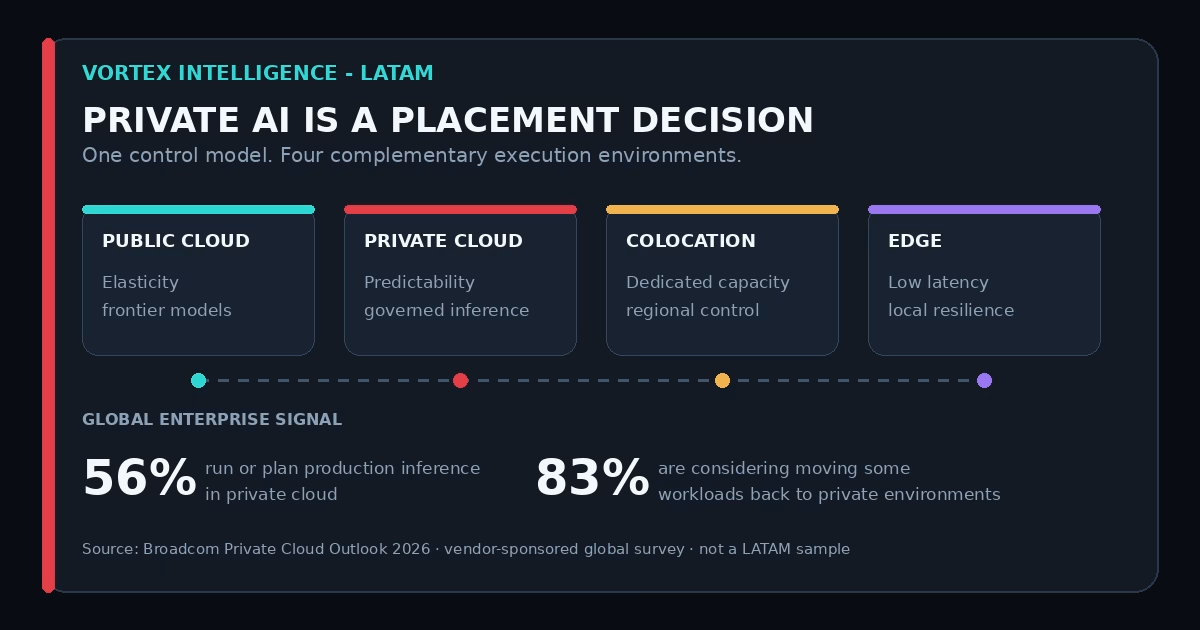
Cost predictability, data control, and inference economics are reshaping enterprise architecture. For Latin American technology leaders, the strategic question is no longer cloud versus on-premises; it is where each AI workload should run, under whose control, and with what exit path.
Executive briefing
Enterprise AI is entering an infrastructure phase. Pilots were often easy to place: a hosted model API, a cloud notebook, a short-lived proof of concept, and a limited dataset. Production systems are different. They generate continuous inference demand, touch operational data, require measurable service levels, and create costs that must survive annual budgeting. That is pulling parts of the AI stack toward private cloud, colocation, and edge environments.
This is not a mass return to the corporate server room. Public cloud still offers elasticity, fast access to new models, and a low-friction path to experimentation. The emerging pattern is hybrid by design: training, experimentation, retrieval, inference, and data storage can live in different environments while policy and observability span them all.
Latin America faces the same architectural pressure with a more uneven base of compute, connectivity, skills, and capital. That makes placement discipline more important, not less.
The production-inference signal
Broadcom’s 2026 Private Cloud Outlook reports that 56% of surveyed enterprises run or plan to run production AI inference in private cloud, compared with 41% in public cloud. It also reports that 83% are considering moving at least some workloads from public to private environments and that 50% have already done so. Cost predictability, security, performance, and control are the recurring motives.
Those figures are a signal, not a neutral map of the entire market. Broadcom sells private-cloud infrastructure, sponsored the research, and surveyed 1,800 senior IT decision-makers across eight countries in North America, Europe, and Asia-Pacific—not Latin America. The result should therefore be read as evidence of a direction among large enterprises, not as a LATAM adoption rate.
A separate Deloitte survey of 515 US enterprise decision-makers points toward the same architectural mix. It found organizations investing simultaneously in centralized AI infrastructure and edge deployments, with cloud-managed edge the most common edge hardware strategy. Again, the sample is not regional. What matters for LATAM leaders is the common operational logic: production AI does not naturally converge on one location.
“Private” is a control model, not an address
The phrase private AI often creates the wrong image: a company buying GPUs, installing them in its headquarters, and training a foundation model alone. That is one possible configuration, but it is rarely the default requirement.
A practical enterprise stack can combine four placements:
- Public cloud for experimentation, burst capacity, frontier-model access, and workloads whose data already lives there.
- Private cloud for predictable, high-volume inference and governed access to sensitive internal data.
- Colocation or sovereign regional infrastructure when an organization needs dedicated capacity without operating power, cooling, and facilities itself.
- Edge infrastructure when latency, intermittent connectivity, operational resilience, or local data handling matters more than centralized scale.
The dividing line is control. Who can inspect the prompts and retrieved documents? Where are embeddings, logs, and model outputs retained? Can a workload move when pricing or regulation changes? Can security teams enforce identity, segmentation, and audit policy across every inference path? A rack in a company building does not answer those questions automatically, and a managed service does not make them disappear.
The strongest architecture is therefore not the one with the most private hardware. It is the one that places each workload deliberately and preserves portability at the data, model, and orchestration layers.
Why the LATAM version is harder
The Inter-American Development Bank’s 2026 regional study describes AI readiness through five infrastructure pillars: data generation, storage, processing, transport, and development environments. It also treats financing, cybersecurity, data governance, sustainability, and human capital as enabling conditions. This is a useful corrective to procurement-first thinking. Buying model access does not close weaknesses elsewhere in the chain.
The ECLAC Latin American Artificial Intelligence Index shows how concentrated that chain remains. It reports that Brazil holds 90% of the region’s supercomputing capacity and that more than half of the countries covered lack critical infrastructure and advanced AI training. Chile, Brazil, and Uruguay lead the index, while much of the region is still building baseline capacity.
At the same time, the GSMA Mobile Economy Latin America 2026 finds that investment in cloud infrastructure, data centers, and connectivity is strengthening the regional foundation. The direction is positive, but availability is not uniform across countries or even across cities within one country.
For a LATAM CIO or CISO, five consequences follow.
First, data gravity can dominate model preference. A slightly less capable model running close to governed enterprise data may produce a safer and more economical service than a frontier model behind an expensive or fragile data path.
Second, currency and contract exposure belong in architecture reviews. Continuous inference priced in dollars can turn an apparently variable operating expense into a strategic dependency. Private capacity can improve predictability only when utilization is high enough to justify it.
Third, connectivity changes the value of edge deployment. The GSMA’s edge-AI analysis for emerging markets argues that bandwidth, latency, and cloud dependence can limit centralized systems. Edge is not a universal answer, but it becomes material in logistics, industrial operations, health services, retail branches, and public services that must continue through a degraded link.
Fourth, regional scarcity makes partnerships part of the architecture. Colocation providers, telecommunications operators, universities, national research networks, and cloud regions can all become components of a sovereign or regulated AI design.
Finally, governance must travel with the workload. Identity, data classification, evaluation, logging, incident response, and model-change control need one operating model even when compute is distributed.
People & Organizational Moves
Gabriel Colloca takes the CIO role at Banco Comafi
In a public announcement, Gabriel Colloca said he has begun a new stage as Director de Tecnología (CIO) at Banco Comafi. The exact title and organization are first-party confirmed.
Organizational signal: Banco Comafi is placing explicit executive accountability over technology while it is publicly experimenting with AI and strengthening cloud and DevSecOps capabilities. The appointment does not prove a specific infrastructure decision, but it makes technology strategy visibly central to the bank’s next operating phase.
Robert Vivar becomes DevSecOps Coordinator at AFP PlanVital
Robert Vivar’s public professional profile lists him as Coordinador DevSecOps at Chile’s AFP PlanVital beginning in July 2026, following work with the organization through a technology-services provider.
Organizational signal: Formalizing DevSecOps coordination inside a pension administrator suggests that software delivery and security control are being joined at the operating-model level. That becomes especially relevant as AI services add new pipelines, identities, datasets, and third-party dependencies to the delivery surface.
These two moves should not be stretched into a regional hiring index. They are concrete, independently visible examples of financial institutions strengthening technology ownership and security-integrated delivery while AI infrastructure choices become more consequential.
What to watch next
The useful indicators will be operational rather than rhetorical:
- Production inference moving into private cloud, regional colocation, or cloud-managed edge—without abandoning public-cloud experimentation.
- Procurement language that asks for portability, data residency, observability, and exit plans instead of merely requesting an “AI platform.”
- Technology organizations combining architecture, data, platform engineering, and security under leaders with production accountability.
- Telecommunications and data-center providers offering smaller, regionally available AI capacity rather than only hyperscale projects.
- Finance teams separating model cost from the full cost of data movement, retrieval, security controls, evaluation, and human oversight.
Enterprise AI is not leaving the cloud. It is leaving the assumption that one cloud, one provider, or one location should serve every workload. In Latin America, the winners will be organizations that turn infrastructure constraints into explicit design choices—and retain the ability to change those choices as the market develops.
Sources
- Broadcom Private Cloud Outlook 2026
- Deloitte Enterprise AI Infrastructure Survey: A 2028 Outlook
- IDB: Development and Use of Artificial Intelligence in Latin America and the Caribbean
- ECLAC: Latin American Artificial Intelligence Index 2025
- ECLAC Digital Development Observatory: ILIA 2025
- GSMA: The Mobile Economy Latin America 2026
- GSMA: Beyond the Cloud—Edge AI for LMICs
- Gabriel Colloca’s public role announcement
- Robert Vivar’s public professional profile