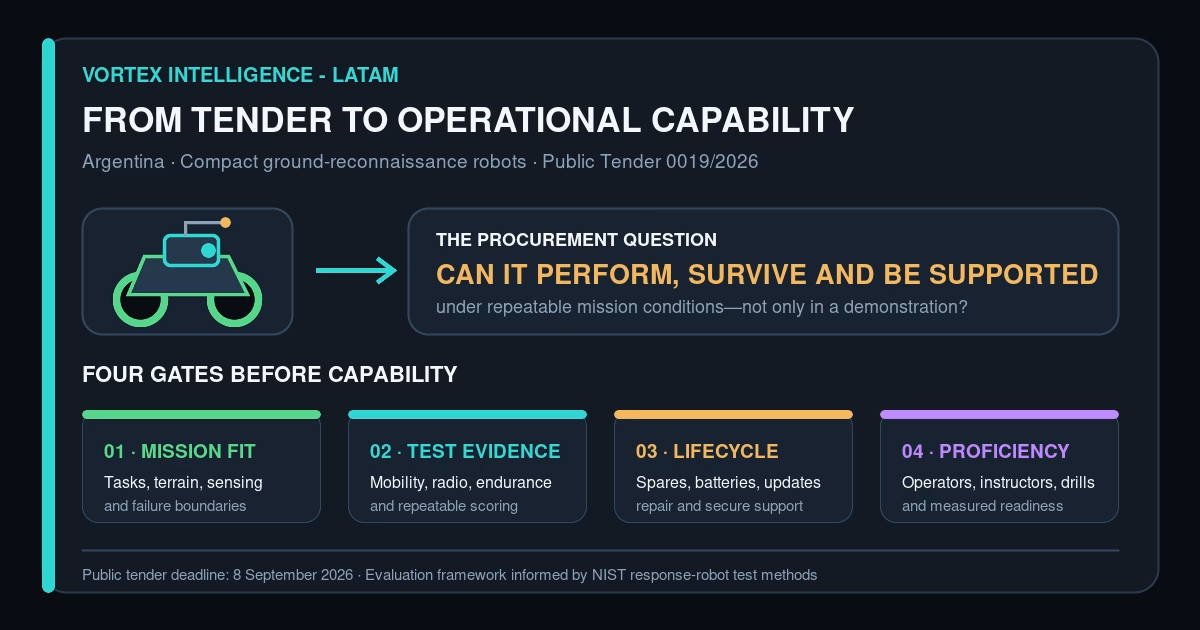
Argentina has opened a tender for compact ground-reconnaissance robots for special forces. The strategic question is not which machine looks most advanced; it is whether the procurement converts operational needs into repeatable tests, supportable systems, and trained capability.
Executive briefing
Argentina’s Ministry of National Security has opened a public tender for compact tactical ground robots intended for reconnaissance by special forces. The official notice in the Boletín Oficial identifies the acquisition, sets August 31 as the deadline for questions, and schedules electronic bid submission and opening for September 8, 2026.
The notice does not publicly establish a vendor, model, quantity, budget, or final technical configuration. That restraint matters. It leaves the most important questions at the procurement layer: how the buyer will compare mobility, sensing, communications, endurance, reliability, operator workload, logistics, and security under realistic mission conditions.
A robot purchase can produce impressive equipment without producing dependable capability. The difference is test design.
What the tender confirms—and what it does not
The public record confirms a national procurement process, run through COMPR.AR, for “compact tactical ground reconnaissance robots for special forces.” It also confirms the administrative timetable. It does not justify guessing which force will receive the systems, what missions will be authorized, whether the platforms will be armed, or which manufacturers are competing.
Those unknowns should remain unknown until official documents resolve them. Compact reconnaissance robots can support many legitimate high-risk tasks: remote observation, inspection of confined spaces, situational awareness around suspicious objects, or reconnaissance in environments where sending a person first would create unnecessary exposure. But a procurement title is not an operational doctrine.
The defensible conclusion is narrower and more useful: Argentina is attempting to add remotely operated ground sensing to a special-operations capability, and the quality of the result will depend on whether the tender evaluates a complete operating system rather than a vehicle plus camera.
A response robot is an extension of the operator
The US National Institute of Standards and Technology defines a response robot as a remotely deployed device that performs operational tasks at operational tempo. Its purpose is to extend the operator, improve remote situational awareness, project the operator’s intent through equipped capabilities, and reduce risk.
That definition shifts attention away from product-sheet spectacle. A platform may have excellent nominal range, camera resolution, or obstacle-climbing claims and still fail in the environment that matters. Radio links degrade behind concrete, underground, inside vehicles, and around reflective structures. Tracks that work on a clean demonstration ramp may bind in debris. A strong sensor package can be undermined by poor low-light performance, unusable controls, weak battery logistics, or a field repair that requires overseas support.
NIST’s response-robot program groups evaluation around maneuvering, mobility, dexterity, sensing, endurance, radio communications, durability, reliability, autonomy, logistics, safety, and operator proficiency. The list is valuable because it prevents one headline specification from substituting for the system.
Procurement should be a test program
The strongest tender would translate mission profiles into measurable thresholds before bids are scored.
Mobility should be tested on reproducible obstacles, stairs, ramps, loose surfaces, narrow passages, and transitions that reflect likely deployment environments. Sensing should be evaluated as an operator task: can a trained user find, identify, and document a target under realistic light, distance, motion, and obstruction?
Communications deserve their own test plan. NIST’s radio-attenuation research exists because wireless performance is not a fixed radius. Building materials, geometry, interference, and non-line-of-sight operation change the link. Buyers should measure graceful degradation, reconnection behavior, latency, video usability, loss-of-link safeguards, and what telemetry remains available when bandwidth collapses.
Endurance should include more than battery runtime on a flat surface. It should measure mission cycles, sensor load, temperature, standby time, battery swaps, charging capacity, and the number of deployable packs an operating unit can sustain. Reliability should be measured across repeated runs, not one successful demonstration.
This is the central procurement principle: vendors should face the same tasks, scoring rules, environmental conditions, and evidence requirements. A comparative field test produces decision data. A showroom demonstration produces impressions.
Interoperability is broader than a connector
Argentina’s security and defense institutions are operating in increasingly complex joint environments. A separate official account of the Daga Atlántica 2026 exercise describes six weeks of combined special-operations training involving Argentine and US forces, with reconnaissance, infiltration, direct-action simulations, evacuation, vehicles, aircraft, communications, and command posts.
That exercise belongs to a different institutional and operational context from the Ministry of National Security tender. It should not be presented as the tender’s purpose or end-user evidence. It does, however, illustrate the wider environment into which specialized systems must fit: multiple units, communications plans, command structures, training cycles, and procedures.
Interoperability therefore cannot be reduced to whether a video connector or data format is available. It includes spectrum management, encryption and key handling, operator roles, evidence retention, identity and access control, map and coordinate conventions, incident logging, maintenance responsibility, and the ability to operate safely when a preferred network is unavailable.
The robot may be compact. Its dependency graph will not be.
The lifecycle is part of the capability
Robotics procurements often concentrate risk after delivery.
First, imported systems can become unavailable through slow spare-parts channels, proprietary batteries, specialized tools, or vendor-only diagnostics. A support plan should identify locally stocked consumables, repair tiers, turnaround times, software-support periods, and the cost of keeping a minimum fleet operational.
Second, software and cybersecurity obligations must survive the warranty. The buyer needs an inventory of firmware and applications, a vulnerability-reporting route, signed-update behavior, supported operating systems, access-control boundaries, log export, and an end-of-support plan. Cloud dependence and remote vendor access should be explicit, not discovered during an incident.
Third, operator proficiency is perishable. NIST’s ground-robot work uses repeatable tests not only for purchasing but also for training and measuring proficiency. A system that only a visiting vendor can operate well is not an operational capability. Training needs instructors, recurring exercises, objective thresholds, fault drills, and a way to qualify replacement personnel.
Finally, doctrine must define when the system adds value and when it creates distraction. Teams need procedures for deployment, loss of communications, damaged equipment, captured equipment, evidentiary material, handoff between operators, and abort criteria. More sensors can create more uncertainty if nobody owns the interpretation.
What a credible award should demonstrate
Before award, the public buyer should be able to show—without disclosing sensitive tactics—that the process answered five questions.
1. Mission fit: Were the required tasks and environments defined before products were compared? 2. Measured performance: Did every bidder face repeatable tests for mobility, sensing, communications, endurance, reliability, and safety? 3. Operational security: Are data flows, updates, credentials, remote access, logs, and failure states governed for the full service life? 4. Supportability: Can trained local personnel keep the systems operational with realistic spares, batteries, tools, documentation, and repair times? 5. Proficiency: Is acceptance tied to operator and instructor performance, not only hardware delivery?
These criteria do not predetermine a brand. They make the award more defensible and the deployed capability more resilient.
The LATAM lesson
Latin American technology policy is often visible in large programs: data centers, national networks, digital identity, or cloud frameworks. Smaller specialized procurements can be just as revealing. They show whether an institution knows how to buy a cyber-physical system whose real performance depends on hardware, radio, software, human factors, logistics, and doctrine at once.
Argentina’s tactical-robot tender is therefore worth watching even before a winner exists. The important signal is not that robots have entered the shopping list. It is whether the acquisition process can turn a new device category into evidence-based, supportable public capability.
If the tender rewards measurable mission performance and lifecycle readiness, the robots may reduce risk and improve situational awareness. If it rewards specifications and demonstrations without a durable test program, the country may acquire advanced machines that are hardest to trust precisely when they are needed most.