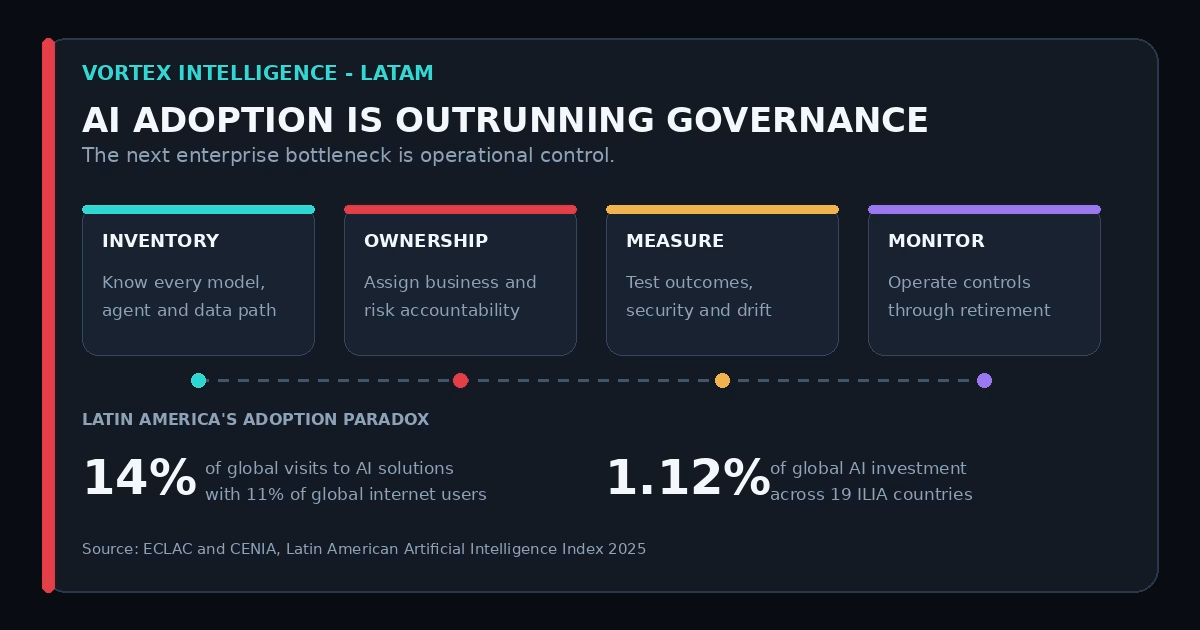
Latin American organizations are not waiting for perfect infrastructure or settled regulation before using AI. The strategic advantage now belongs to enterprises that can turn fast adoption into a controlled operating capability.
Executive briefing
Latin America has entered an AI adoption paradox. Usage is growing faster than the region’s share of global digital activity, yet investment, advanced talent, infrastructure, and policy execution remain highly concentrated. For enterprise leaders, that combination creates a specific risk: AI can spread across business processes before the organization has built an inventory, assigned ownership, defined acceptable use, or established ways to measure whether systems remain safe and useful.
The response should not be a centralized approval queue that freezes experimentation. It should be an operating system for AI: a small set of controls that follows each use case from discovery through retirement, with stronger requirements where consequences are higher.
This is especially important as generative models move beyond individual productivity into software delivery, customer service, fraud analysis, marketing, internal knowledge, and agentic workflows. The model is only one component. Data access, retrieval, tools, identities, human decision rights, monitoring, and vendor dependencies determine the real risk.
The regional adoption paradox
The Latin American Artificial Intelligence Index 2025, produced by Chile’s CENIA with ECLAC, reports that Latin America and the Caribbean account for 14% of global visits to AI solutions while representing 11% of global internet users. The same index says the 19 countries it covers receive only 1.12% of global AI investment.
That is not evidence that the region is uniformly ahead. It shows demand moving faster than the foundations beneath it. Chile, Brazil, and Uruguay lead the index, while more than a third of assessed countries remain in the earliest maturity group. Ninety percent of regional supercomputing capacity is concentrated in Brazil. AI literacy scores are materially stronger than professional and advanced-specialist training.
The governance picture is similarly uneven. ECLAC’s summary describes national strategies that often lack budgets, implementation mechanisms, and evaluation. The institutional lesson has a direct enterprise equivalent: an AI policy without an inventory, owners, controls, and evidence is a declaration rather than a management system.
The Inter-American Development Bank’s 2026 infrastructure study reinforces the point. It frames AI readiness across data generation, storage, processing, transport, and development environments, surrounded by financing, cybersecurity, data governance, sustainability, and human capital. A company may buy access to a capable model while remaining weak in several of those adjacent layers.
Governance must become an operating capability
Governance is often discussed as a legal or ethics function. Both matter, but production AI also needs the disciplines used to run any consequential technology service: named owners, change control, measurable performance, security testing, incident handling, supplier management, and an exit path.
NIST’s AI Risk Management Framework organizes that work around four functions: govern, map, measure, and manage. Governance is cross-cutting rather than a final review. Mapping establishes context and intended use. Measurement tests performance and risk. Management prioritizes and treats what the organization finds.
ISO/IEC 42001 reaches a compatible conclusion from a management-system perspective. It specifies a structure for establishing, implementing, maintaining, and continually improving an AI management system. The important word is continually. A model or agent that was acceptable at launch can change through new prompts, tools, data, vendor versions, user behavior, or business scope.
These frameworks should not become paperwork competitions. Their practical value is that they convert vague responsibility into repeatable decisions.
Six controls that should travel with every AI system
1. Inventory the system, not just the model
An AI register should identify the business purpose, owner, users, model and service providers, data sources, retrieval stores, connected tools, deployment environment, and downstream decisions. A chatbot that only drafts internal text is not the same system after it gains access to customer records or the ability to trigger transactions.
The inventory should include unsanctioned but tolerated use. If employees are already using consumer AI services, the starting point is visibility and safer alternatives—not pretending adoption has not happened.
2. Assign two accountable owners
Every production use case needs a business owner responsible for value and outcomes, plus a technology or risk owner responsible for controls and evidence. Shared committees can advise, but they cannot replace a person who can stop a deployment, accept residual risk, or fund remediation.
Ownership also clarifies who responds when an output is wrong, a provider changes terms, or a workflow begins consuming more tokens, data, or human review than expected.
3. Classify consequence before choosing controls
Controls should scale with impact. Low-consequence drafting can move quickly with disclosure and data restrictions. Systems affecting employment, credit, health, identity, security, public benefits, or large financial decisions require stronger validation, logging, human review, and challenge mechanisms.
The IDB’s 2025 regulatory framework for the region argues for proportionate and adaptive approaches rather than one uniform rule. Enterprises need the same proportionality internally.
4. Test the complete workflow
Model benchmarks are insufficient. Test retrieval quality, access boundaries, prompt injection resistance, tool authorization, failure behavior, latency, cost, and the human handoff. Measure performance on local language, terminology, customers, and operating conditions rather than assuming a global benchmark transfers cleanly.
NIST’s framework emphasizes validity, reliability, security, resilience, transparency, and regular evaluation. Those outcomes belong in release gates and production monitoring, not only in procurement questionnaires.
5. Make data and vendor exits explicit
For each system, record what data leaves the organization, what the provider retains, where logs live, which subprocessors participate, and how the workflow can be disabled or moved. Vendor concentration becomes operational risk when prompts, embeddings, evaluations, and orchestration are inseparable from one service.
Latin America’s uneven infrastructure and currency exposure make this more than a compliance concern. A system may be technically successful and still become unsustainable because of dollar-denominated inference, data-transfer costs, connectivity, or the disappearance of a regional service.
6. Monitor through retirement
Production controls should detect quality drift, unsafe use, privilege changes, abnormal cost, new data exposure, and vendor updates. Incidents need a defined route into security, legal, privacy, model owners, and affected business teams.
Retirement deserves equal attention. Disable tools and credentials, preserve required records, remove stale indexes, communicate replacement workflows, and verify that unofficial copies do not continue operating.
From principles to evidence
The gap between principles and execution is already visible in public-sector experiments. UNESCO’s Latin American Ethical Impact Assessment pilots included systems in Bogotá, Paraguay, and Peru. The pilots surfaced practical issues such as privacy, transparency, interoperability, regulatory alignment, and contextual adaptation. Their value was not another statement of ethics; it was applying a method to actual systems.
Enterprises can take the same approach. Start with a small portfolio of real use cases, not an abstract enterprise policy. Build the inventory, consequence tiers, evidence requirements, and review cadence around what teams are deploying now. Use each review to improve templates and automation.
The first automation targets should be mundane: model and vendor metadata, data-classification checks, evaluation results, approval history, expiry dates, and alerts when a connected tool or provider version changes. Governance becomes scalable when evidence is generated by the delivery process instead of reconstructed before an audit.
What to watch next
- AI inventories becoming part of architecture and asset-management systems rather than isolated spreadsheets.
- Security teams evaluating agents as identities with permissions, not merely as software features.
- Procurement requiring exportable logs, evaluation access, data-retention clarity, and termination assistance.
- Business owners accepting measurable accountability for AI outcomes and operating cost.
- Regional regulators and industry bodies shifting from principles toward testing, reporting, and impact-assessment mechanisms.
- Organizations measuring whether governance speeds safe deployment instead of counting how many reviews it blocks.
Latin America does not need to delay AI until every structural gap is closed. It needs management systems that acknowledge those gaps while allowing controlled progress. The decisive capability will not be access to the newest model. It will be the ability to know where AI is operating, what it is allowed to do, how well it is performing, and who can intervene when conditions change.
Sources
- ECLAC and CENIA: Latin American Artificial Intelligence Index 2025
- ECLAC Digital Development Observatory: ILIA 2025 data and facts
- IDB: Development and Use of Artificial Intelligence in Latin America and the Caribbean
- IDB: An Enabling Regulatory Framework for Artificial Intelligence in Latin America and the Caribbean
- NIST: AI Risk Management Framework Core
- ISO: ISO/IEC 42001 AI management systems
- UNESCO: Piloting the Ethical Impact Assessment in Latin America