Spanish technology group knowmad mood announced its acquisition of 100% of Argentina’s Danwor on November 17. Danwor specializes in data architecture, analytics, enterprise planning and applied AI, particularly around SAP. Its founders will continue to run the business. The deal gives knowmad mood another Latin American delivery team and a more specialized route into enterprise data projects.
For customers, the immediate question is practical: can a larger services group make a data platform easier to operate across SAP, Databricks and Google Cloud without making accountability harder to locate? The buyer says those three ecosystems are part of Danwor’s capabilities. That is a description of the combined offering, not proof that any individual customer’s integration will improve.
What the transaction actually establishes
Knowmad mood says Danwor has more than 70 professionals and around 40 international clients. It reports 2025 revenue of US$3.9 million and EBITDA of US$1 million, and forecasts more than US$4.4 million and US$1.3 million respectively for 2026. Those are buyer-reported figures and forecasts, not a customer outcome measure.
The buyer’s investor communications page lists the acquisition of Danwor’s entire capital. Its announcement says founders Brian Jawor and Gastón Jordán will continue to manage the company and that current projects retain their existing people and contacts. It does not establish a purchase price or publish a customer-level service guarantee. A figure circulated in a private industry newsletter should not be treated as a disclosed deal value.
The group presents the deal as part of its 2025–2028 plan. It also points to its acquisitions of Argentina’s CDA Informática and Germany’s MuniConS during the second half of 2026. The pattern suggests a growing cross-border services portfolio. Whether that portfolio makes delivery simpler depends on the controls customers can see and test.
Danwor’s stated specialization matters because enterprise AI rarely begins with a model selection. The harder work is establishing whether transaction records, customer definitions and access rules survive movement between older systems and new analytics platforms. A services acquisition may bring more specialists to that work, but it can also move design decisions into a different management structure. Buyers of these services should evaluate the operating model alongside the technology stack.
The deal announcement names SAP Datasphere, SAP Business Data Cloud, SAP Analytics Cloud and SAP BW among Danwor’s areas of experience. That range suggests projects can span legacy warehouses, cloud data services and business-facing planning. It does not imply every tool is used by every customer. An organization should inventory its own installed versions, integrations and licenses before treating a vendor capability statement as an architecture recommendation.
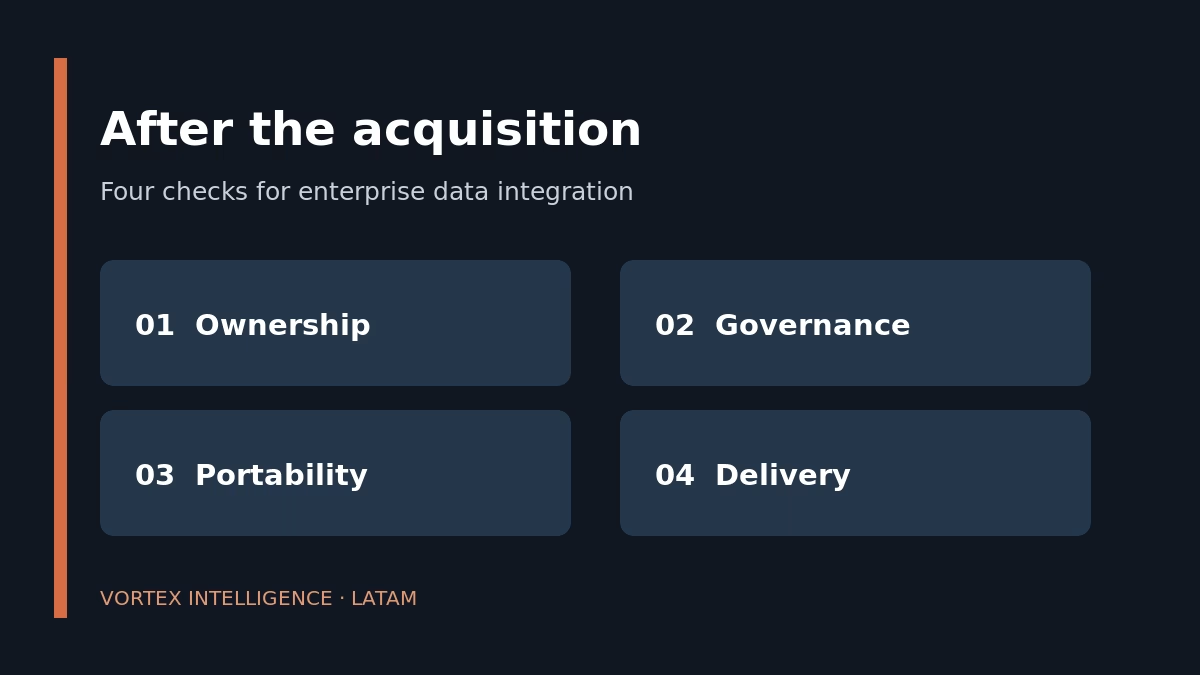
A four-part integration test
Map ownership of the data path. Draw the actual route from SAP source systems through extraction, transformation, storage and reporting. Name the team responsible for each interface, schema change and failed job. Ask whether the acquisition changes any owner, subcontractor or escalation path.
The map should include batch schedules, streaming links, manually uploaded spreadsheets and downstream applications that quietly depend on the output. Label each boundary with the system of record and the business owner who can approve a definition change. If a field called “revenue” has several meanings, document the rule used by each dashboard. A precise map prevents a supplier reorganization from hiding an old ambiguity under a new project name.
For current projects, ask for a named technical lead and a named commercial owner. They may be different people, and both must know who can authorize a change to scope, price or data handling. The buyer says Danwor’s current projects retain their people and contacts; customers can verify that against the actual project roster and escalation procedure. A departure or handoff later should trigger a documented transfer of design decisions, open incidents and outstanding assumptions.
Check governance where systems meet. Document who can change access rules, data definitions and retention policies in each platform. A shared sales offering does not automatically create a shared control plane. Require a way to trace a report or AI output back to the data version and transformation that produced it.
Ask which party administers service accounts and privileged roles. Require a periodic review of access granted to the delivery team, including temporary privileges used during migration. When data moves between platforms, confirm how classification labels and deletion requirements travel with it. A pipeline that copies a restricted table into a broadly accessible workspace is a governance failure even if every job succeeds technically.
For AI use cases, test a small claim from end to end: can the team show the source record, transformation, permission decision and model or application output? The answer should be reproducible by someone other than the original developer. This is particularly useful when a prototype becomes a production workflow and a different team inherits support. Put the trace in the acceptance criteria before adding more data sources.
The platforms have their own governance mechanisms and limits. SAP’s Datasphere documentation describes data access controls on protected views. Databricks documents lineage visibility through Unity Catalog permissions. Google Cloud documents lineage for supported services and custom sources through its Data Lineage API. These are useful building blocks, but each has a scope. An end-to-end trace across all three still needs an explicit design and a test using the customer’s actual pipeline.
Prove portability and recovery. Test export of a representative dataset, its metadata and its transformation logic. Run a restore or rebuild exercise with measured time and data loss. Portability claims are weak if a customer can export tables but cannot reproduce the pipeline that made them useful.
Include orchestration schedules, infrastructure configuration, mapping rules, secrets references and documentation of any vendor-specific services. The test should identify which pieces can be moved with normal export tools and which would require reimplementation. Record the labor involved; a technically possible exit may still be prohibitively expensive without advance planning. The same inventory supports disaster recovery, contract renewal and internal audit.
Recovery should also be tested against real failure modes. A broken connector, accidental schema change and revoked credential have different owners and response times. Run at least one exercise in which the primary operator is unavailable. If only one engineer can rebuild the pipeline, the organization has a continuity risk regardless of how many employees the enlarged supplier has.
Measure the new operating model. Record current incident response, change lead time, delivery ownership and pricing terms before any contract refresh. Review those measures after two release cycles. The founders’ continued management is a useful continuity signal; only delivery evidence will show whether it survives the integration.
Use a small scorecard with dates and observable facts: time to acknowledge a severity-one incident, time to restore a failed data feed, percentage of changes with a rollback plan, and number of unresolved data-definition disputes. Ask for separate reporting on incidents caused by customer systems and by supplier-managed components. The point is to discover responsibility quickly, not to produce a decorative vendor grade.
Contract terms need the same attention. Confirm who owns deliverables, whether subcontractors or group companies can access customer data, which legal entity invoices and supports the service, and what notice applies if those arrangements change. An acquisition can leave a project team intact while altering contractual or data-processing relationships. Those changes should be visible before a renewal, not discovered during an incident.
For a new proposal, ask the supplier to separate a proof of concept from a production commitment. The proposal should name data-quality assumptions, target service levels, migration and rollback work, and who maintains the solution after launch. A demonstration that connects two platforms is evidence of feasibility. It is not evidence of long-term support cost or of reliable operation under real permissions and volume.
The acquisition could help customers assemble SAP and newer data services with a broader team. It could also introduce an extra organizational boundary. A short, evidence-based review of the four areas above makes that trade-off visible while contract and architecture choices are still reversible.
The broader regional signal is that a specialist Argentine data firm is being incorporated into an international services group that says it wants more Latin American delivery capacity. The announcement provides evidence of the transaction and the buyer’s intentions. It does not prove future hiring, project performance or customer savings. Technology leaders can respond without waiting for those uncertain outcomes: document the existing data estate, preserve exit options and measure whether the combined supplier makes delivery more accountable over time.
Sources
- Knowmad mood: Danwor acquisition announcement, November 17, 2026
- Knowmad mood: investor communications, including the 100% capital acquisition notice
- SAP Help: securing data with Datasphere access controls
- Databricks documentation: Unity Catalog lineage
- Google Cloud documentation: Knowledge Catalog data lineage