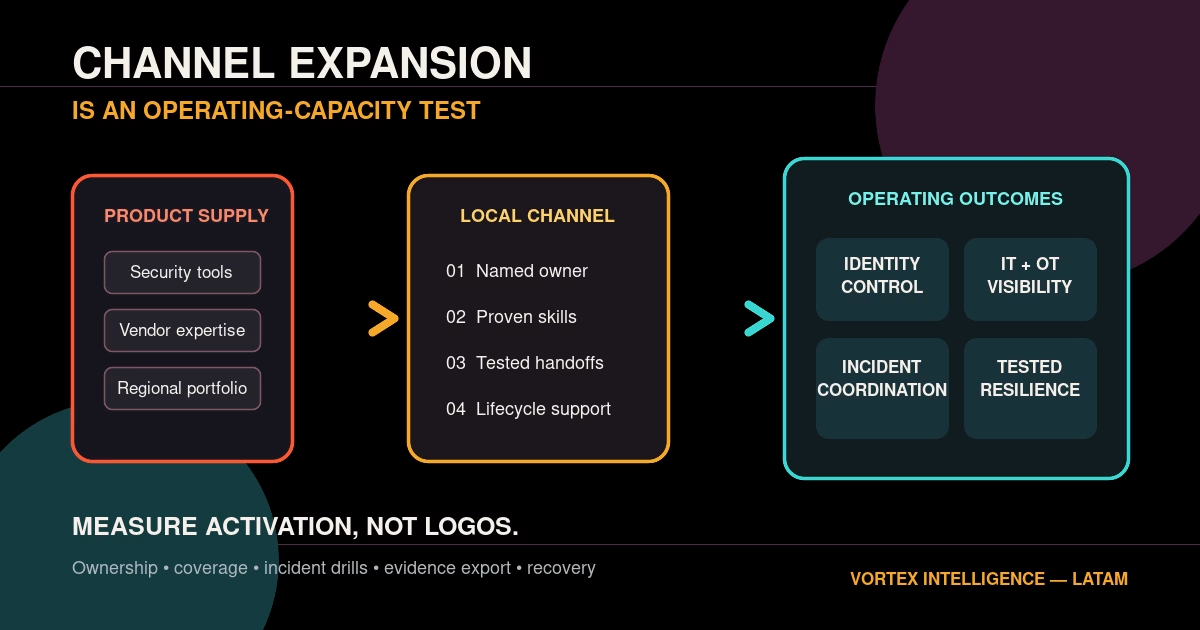
Argentina is attracting another kind of cybersecurity investment: not only products arriving through regional catalogs, but distributors building a direct local channel. That is useful market evidence. It also creates a sharper test for buyers. More vendors and more local coverage matter only when they produce deployable controls, accountable support and faster recovery.
CLM’s first-party Argentina page describes a Buenos Aires operation focused on cybersecurity, digital infrastructure, identity, cloud and operational technology. The company presents itself as a value-added distributor connecting manufacturers with integrators and partners, supported by technical enablement, training and go-to-market services. Its local corporate page also says the operation is strengthening Argentina’s channel ecosystem. CLM Argentina and CLM corporate site.
This is one company’s market move, not proof of an industry-wide investment wave. It is nevertheless a useful signal: suppliers see enough demand to place people and channel-building capacity closer to Argentine customers. The strategic question for CIOs and CISOs is how to turn that expanding supply into operating capacity rather than a longer list of logos.
The demand signal is operational
Argentina’s CERT.ar registered 520 security incidents in 2025, 19% more than in 2024. Phishing remained the largest category with 211 cases, while account compromise rose to 150 cases. The State accounted for 254 incidents and Finance for 127; the latter was up 170% year over year. More than 92% of all registered incidents were classified as high or critical severity. CERT.ar 2025 annual incident report.
Those figures are not a census of every attack in Argentina. They reflect incidents registered through official channels and automated feeds, so reporting and collection practices affect the totals. Their value is more specific: they show what the national response team had to manage and where the recorded pressure concentrated.
The composition is especially important. CERT.ar says account compromise became the leading incident type inside the State, surpassing phishing. That moves the problem beyond awareness campaigns. Identity lifecycle, multi-factor authentication, privileged access, session monitoring and recovery procedures become production controls, not optional hygiene.
Public policy is moving in the same operational direction. A 2026 technical regulation requires national public-sector contingency policies, plans and alternate data-processing centers. The 2025 reorganization of federal cybersecurity responsibilities also assigns explicit functions around critical infrastructure, incident response, resilience, secure software and recurring vulnerability testing. Centro Nacional de Ciberseguridad Disposition 1/2026 and Decree 274/2025.
The implication is not that every private company inherits public-sector requirements. It is that the Argentine market is being asked to demonstrate continuity and response, not merely prevention.
A larger catalog is not the same as a stronger defense
Channel expansion can reduce real constraints. Local partners can improve language coverage, contract handling, deployment support, training and escalation. A distributor can also help a specialized manufacturer reach organizations that could not maintain a direct relationship with every supplier.
But the channel can amplify weak purchasing habits too. If buyers select products independently, each new tool brings another console, identity boundary, data-retention policy, support queue and integration dependency. Visibility fragments. Alerts accumulate. Nobody owns the cross-product failure path.
The correct unit of procurement is therefore not the product. It is the operating outcome.
Consider identity. An organization buying privileged-access management, identity governance and endpoint detection from different suppliers should test one end-to-end case: a privileged credential is compromised, used from an unusual context and then revoked. Can the combined system detect the event, contain access, preserve evidence and restore a legitimate administrator without improvisation?
For operational technology, test a remote-maintenance path. Who authorizes the session? Which intermediary records it? What happens when the security platform or the internet link is unavailable? Can the plant continue safely while access is restricted? Product features become valuable only when the organization can answer those system-level questions.
Treat the channel as part of the security architecture
A distributor, integrator and managed-service provider may participate in design, configuration, licensing, telemetry, support and incident response. That makes the commercial chain part of the technical control plane.
NIST’s Cybersecurity Framework 2.0 supply-chain guidance recommends establishing supplier requirements, performing due diligence before formal relationships, monitoring supplier risk through the lifecycle and including relevant third parties in incident planning, response and recovery. The guidance is voluntary and is not an Argentine legal requirement, but its operating logic travels well. NIST SP 1305.
For an Argentine buyer, that logic can become five concrete contract tests.
First, name the accountable local party. “Regional support” is not enough. The contract should identify who receives a severity-one case in Argentina, which organization owns the ticket and when escalation reaches the manufacturer.
Second, verify skills rather than badges. Ask which engineers have deployed the exact product version in a comparable environment, which capabilities are local and which depend on another country or time zone.
Third, test the evidence boundary. Determine which telemetry the integrator, distributor and manufacturer can access; where it is stored; how long it is retained; and how a customer exports it during an incident or at contract termination.
Fourth, rehearse a shared incident. Include the customer, integrator, distributor and manufacturer in one tabletop or technical exercise. Measure acknowledgment, diagnosis, decision authority and evidence handoff. A support matrix that has never been exercised is an assumption.
Fifth, define the exit. License portability, configuration export, log retention, replacement access and secure deletion should be clear before deployment. A local relationship can reduce dependence on a remote vendor while creating a new dependence on the channel partner. Both need governance.
Convert vendor breadth into four control planes
An expanding supplier ecosystem is most useful when the portfolio is organized around a small number of outcomes.
The first is identity control: phishing-resistant authentication where feasible, privileged-access boundaries, service-account ownership, rapid revocation and tested recovery. CERT.ar’s account-compromise data makes this the most immediate control plane.
The second is IT and OT visibility: asset inventory, network context, remote-access control and detections that distinguish business traffic from unsafe behavior. Adding an OT security platform without clarifying engineering ownership can create monitoring without authority to act.
The third is incident coordination: normalized evidence, severity rules, escalation ownership and a path to share indicators with trusted response partners. CERT.ar attributed 254 reports to automated feeds in 2025, nearly half its total. That demonstrates the value of machine-readable exchange, while also reminding buyers that a feed is only useful when someone can evaluate and respond to it.
The fourth is resilience: recoverable identity, alternate processing, immutable or isolated backups, restoration drills and explicit degraded modes. A product that blocks attacks but cannot support safe recovery covers only half the operating problem.
This framing helps prevent portfolio-driven architecture. Vendors can change while the four outcomes remain stable. It also lets a buyer compare competing channel proposals on integration, staffing and recovery instead of accepting feature-count comparisons.
Use a 90-day activation scorecard
A local distributor’s success should be visible before annual renewal. Buyers and channel leaders can track a compact 90-day scorecard for each deployment:
- time from contract to a production control with a named owner;
- percentage of in-scope identities or assets actually covered;
- verified integration with the incident and change-management workflows;
- number of local engineers capable of first response without manufacturer intervention;
- outcome of one failure or recovery drill;
- unresolved critical findings and their accountable owners;
- time and completeness of one evidence export.
These measures should not become another vanity dashboard. Coverage without testing can be misleading, and a fast deployment can be unsafe. The scorecard is useful because it forces the commercial promise, technical implementation and response process into the same review.
For distributors, the corresponding opportunity is larger than resale. Publish support boundaries, maintain version-specific expertise, help partners run exercises and make escalation performance measurable. The channel that can show operational evidence will be more valuable than one that merely offers the widest line card.
The market test
CLM’s arrival adds capacity and competition to Argentina’s cybersecurity channel. That is positive, but the durable market signal will come later: local deployments that reduce account compromise, improve visibility across IT and OT, and recover cleanly when controls fail.
The next procurement conversation should therefore begin with a scenario, not a product category. Ask the proposed channel to walk through one compromised identity, one disrupted remote-access path and one recovery event. Identify every handoff and every decision owner.
Argentina does not need fewer security products. It needs each selected product to become part of a system that people can operate under pressure. Channel expansion is valuable when it closes that gap.