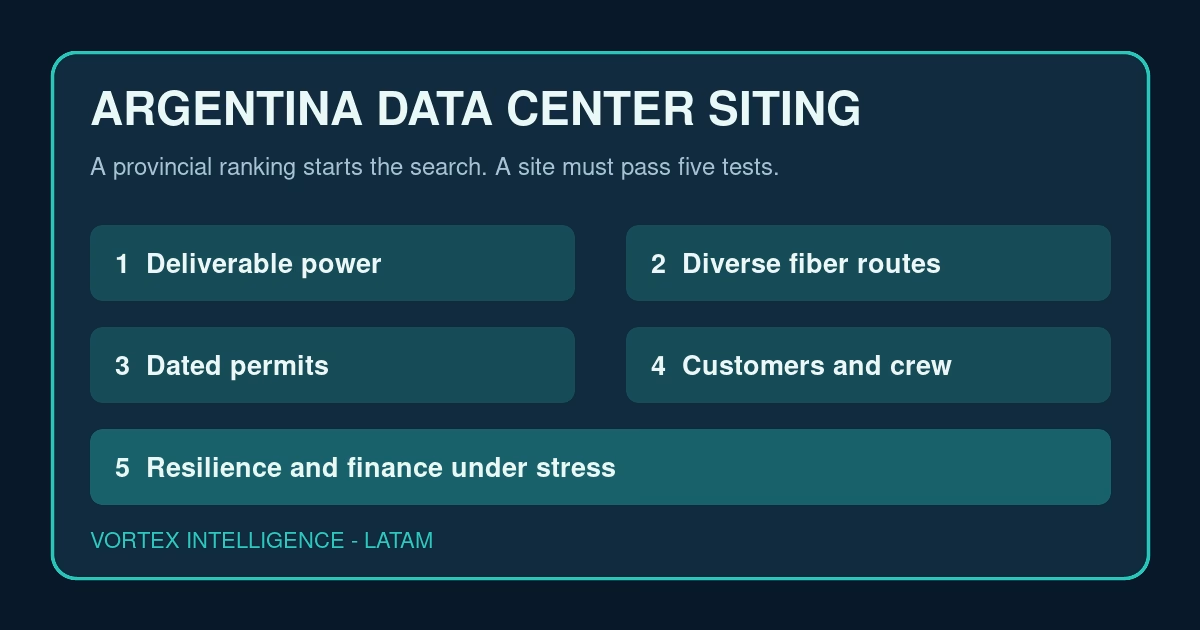
Argentina has a new map of where data center investment might go. The Argentine Internet Chamber, CABASE, compared all 24 jurisdictions using energy, connectivity, provincial turnover tax, investment incentives, and technology talent. Río Negro leads the illustrative ranking, followed by Buenos Aires, Neuquén and the City of Buenos Aires. For investors and technology leaders, its best use is as a screening tool: a province-level score can narrow a search, but it cannot certify a particular plot’s power, network routes, permits, or economics.
That distinction matters because the study points to a real geographic gap. CABASE counts 15 operating facilities above one megawatt, with approximately 35 MW of installed capacity. It says 60% of that capacity is in the City of Buenos Aires and the remaining 40% in Greater Buenos Aires. Those figures describe the facilities in its scope, not every enterprise server room or a forecast of demand. A new facility outside the metropolitan area could improve regional resilience, but only if the project clears physical and commercial tests that a broad ranking cannot settle.
Read the weights before the winners
CABASE gives energy and connectivity 30% each, investment incentives 20%, and turnover tax and talent 10% each. It explicitly says the weights are an example. That is a useful disclosure, not a defect: a hyperscale AI cluster, an enterprise disaster-recovery site, and a regional colocation facility have different constraints. If an investor changes the weights, the order can change. Treating the published order as a permanent league table would give the illustrative scoring more authority than CABASE claims for it.
The International Energy Agency’s 2025 Energy and AI report explains why energy deserves close scrutiny. Data centers represented about 1.5% of global electricity use in 2024, yet their local impact is concentrated. The agency’s central projection more than doubles global data center demand by 2030. These are global estimates, not Argentine forecasts. Their practical lesson for an Argentine site search is narrower: a grid connection and the time needed to deliver it can decide a project’s schedule even when a province has attractive energy resources.
An IEA update published in April 2026 reported that data center electricity use rose 17% in 2025 and warned about concentrated loads, new generation and grid investment. The Uptime Institute’s 2026 survey summary likewise identifies power availability, capacity forecasting and supply chains as growing concerns for operators. Neither source validates any specific Argentine project. Together, they explain why a site score should trigger detailed engineering questions rather than end them.
Five tests for a candidate site
1. Deliverable power, not just nearby generation. Ask the distributor or transmission operator for a dated connection study: available firm capacity, point of connection, required substations or lines, upgrade owner, cost allocation, and realistic energization date. Then model the load in stages, including cooling and redundancy, rather than quoting only IT equipment demand. A region may generate abundant electricity while a particular parcel still waits for transmission capacity. Require a separate answer for backup generation, fuel logistics, emissions obligations, and the conditions under which those systems may operate.
2. Network diversity, not just an IXP on a map. CABASE’s IXP network lists 28 exchange points across Argentina. That is a significant foundation for regional connectivity, but an exchange point does not guarantee two physically independent fiber routes to a selected building. Request route maps, provider and duct diversity, protected paths, restoration commitments, and measured latency to the customers and cloud regions the facility intends to serve. A single shared bridge, conduit or upstream provider can undo a promising redundancy diagram. The site decision needs a network design that survives a plausible common-cause failure.
3. A permitting path with dates. Identify the authority for land use, construction, environmental review, water, backup power, and grid works. Record which approvals are required before financing, construction and operation. A province’s incentive regime may help the business case, but it does not issue municipal permits or resolve a utility connection. Ask counsel and local engineers to identify the binding conditions in writing. An investment decision should distinguish an incentive announced by government from one actually applicable to the project’s legal entity and timeline.
4. Customers and operating capability. Estimate committed demand by workload and latency requirement. An AI training facility, a low-latency financial platform and a disaster-recovery site do not share one optimal location. Confirm whether operators, electricians, cooling specialists, fiber technicians, security staff and replacement parts can support the facility around the clock. CABASE includes talent in its matrix, but provincial employment and university indicators cannot prove that a specific shift roster is available for a particular facility. Test the staffing plan against the proposed launch date and travel time to the site.
5. Resilience and financing under stress. Model a delayed power connection, a slower customer ramp, higher imported-equipment cost, and a currency or tax change. Set a minimum acceptable project return under those scenarios before the preferred location becomes emotionally fixed. A data center is hard to relocate once the civil works and electrical plant are built. Investors should ask which risks sit with the developer, the grid operator, customers, contractors and insurers, and whether the contracts align those responsibilities. This is a project-level inference from the assets’ long life, not a measured finding in CABASE’s ranking.
These tests should produce a comparable evidence pack for each shortlisted site. Record the same proposed IT load, redundancy target, customer mix, commissioning date and financing assumptions for every candidate. Put a date and owner next to each unanswered dependency. If one site has a confirmed utility connection while another has only a verbal estimate, that difference should be visible even if the latter province scores higher in the national model. The pack should also say what evidence would change the decision: for example, a binding connection offer, a second fiber route survey, or a permit ruling. This discipline prevents a promising policy announcement from being mistaken for completed infrastructure.
The sequencing is important. Power and network feasibility should be established before a team spends heavily on detailed design. Permitting and customer demand should then be tested against the same schedule. Finally, finance and insurance should price the residual risks that engineering cannot remove. A failed gate does not mean a province is unattractive forever; it means the proposed facility, at that site and date, lacks a verified path to operation.
A useful national map with a local decision still to make
CABASE’s score can help public officials see where policy and infrastructure may be improved. It can also help investors compare an initial long list. Its own description says the five-factor weighting is illustrative, and its facility count shows how concentrated current installed capacity remains. Those are valuable starting facts. The next step is to replace province-wide proxies with site-specific evidence and to compare projects on the same workload, schedule and risk assumptions.
For a technology buyer, the question is not simply whether Río Negro outranks Buenos Aires. It is whether a candidate facility can deliver the power, connectivity, operating resilience and contractual terms the application actually needs. For a province, the question is which bottleneck can be removed with a credible date and responsible owner. A ranking creates a conversation. Bankable infrastructure requires the answers.