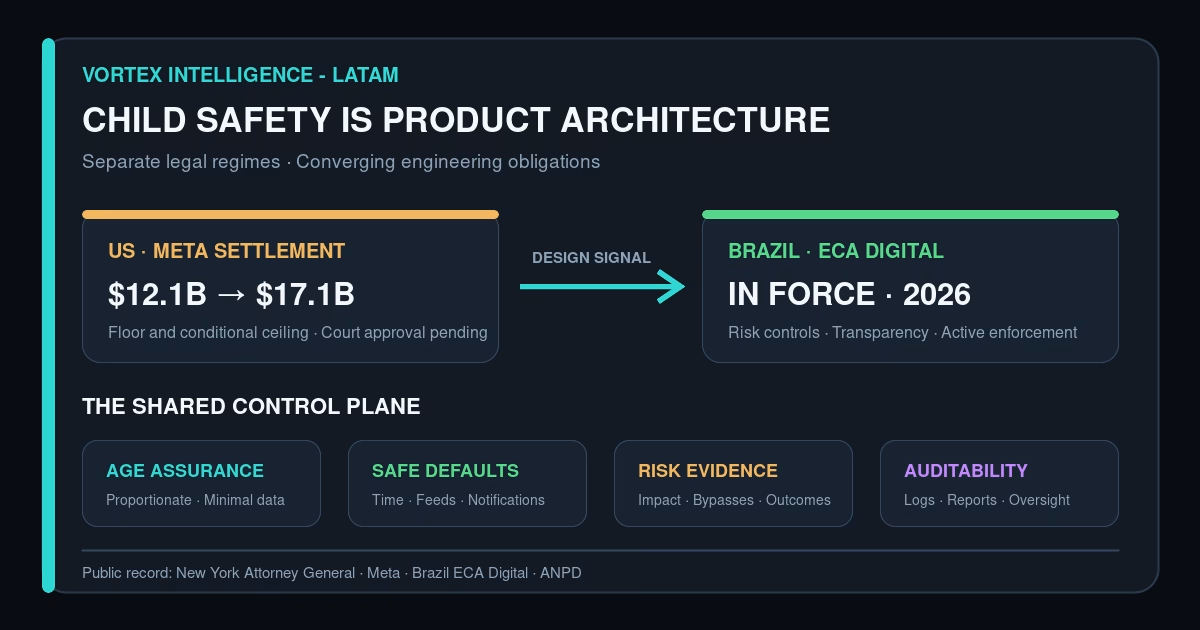
The US agreement is not Latin American law. Its product controls nevertheless arrive at the same moment Brazil is turning child protection into an auditable platform obligation. The common message is clear: youth safety is moving from policy language into system design.
Executive briefing
Meta has reached a settlement with US state attorneys general that would impose major changes on how minors use Facebook and Instagram. The New York Attorney General describes a payment floor of USD 12.1 billion and a ceiling of USD 17.1 billion, subject to court approval. The agreement also calls for age assurance, a two-hour daily limit for minors, nighttime restrictions, reduced notifications, and stronger parental controls.
Meta’s own account describes approximately USD 18 billion allocated over ten years, with part of the amount conditional on TikTok and YouTube adopting comparable measures. The parties therefore frame the headline total differently. The durable fact is not one rounded number. It is that design choices once treated as engagement optimization are now attached to multibillion-dollar liability, operating restrictions, and independent oversight.
For Latin American technology leaders, this is not a prediction that the US settlement will automatically apply across the region. It will not. The relevant signal is structural: regulators are increasingly asking whether a platform can prove that its defaults, age controls, recommendation systems, notification patterns, and escalation processes protect minors by design.
Brazil is already making that question operational.
The settlement turns safety promises into controls
The US framework matters because it is unusually concrete. According to the New York Attorney General, Meta must identify users under 18, restrict minors’ daily use, limit nighttime access, suppress notifications during defined periods, and allow families to avoid addictive algorithmic feeds. Meta says the agreement also includes recurring prompts during continuous use, stronger parental supervision, and more technology to identify accounts that misstate their age.
Those are not content-moderation slogans. They are product requirements with implementation consequences:
- identity and age-band inference;
- policy enforcement across multiple accounts and apps;
- time-window controls tied to local context;
- recommendation and notification settings that vary by age;
- parent-child authorization flows;
- compliance telemetry that can withstand independent review.
Meta says an independent auditor will assess compliance annually for five years. That changes the engineering objective. A control is not complete because a user interface exists. It must behave consistently, produce reliable evidence, and resist obvious bypasses.
The agreement also exposes a difficult system boundary. Meta argues that protections work better when competing platforms adopt the same standard because teenagers move between services. That is directionally reasonable, but it does not remove each provider’s responsibility. Cross-platform displacement is a policy problem; weak controls inside one platform remain that platform’s problem.
Brazil has already crossed from principle to implementation
Brazil’s Law 15.211/2025, the ECA Digital, entered into force in March 2026. Its reach is broader than social networks: it applies to technology products and services directed at, or likely to be accessed by, children and adolescents in Brazil.
Several provisions map directly onto product architecture. The law requires protective privacy defaults, risk management for features and systems, and configurations designed to avoid compulsive use by minors. It requires age-appropriate experiences and assigns app stores and operating-system providers responsibilities for proportionate, auditable, technically secure age assurance. It also limits age-verification data to that purpose and requires data minimization rather than unrestricted identity sharing.
This combination matters. “Verify age” cannot become permission to build a new surveillance layer. A defensible architecture has to answer two questions at the same time:
1. Can the service reliably apply age-appropriate protections? 2. Can it do so without collecting or distributing more personal data than necessary?
Brazil’s data-protection authority, the ANPD, is now developing guidance and enforcement around those obligations. Its ECA Digital program includes regulatory work on age-assurance mechanisms. In August, the authority opened an enforcement proceeding involving Discord, citing possible failures involving serious-harm prevention, age assurance, removal, and reporting duties. The investigation does not establish a final violation, but it shows the law is not merely aspirational.
The reporting clock is also running. The ANPD says platforms with more than one million registered users under 18 must publish their first ECA Digital transparency report by September 17, 2026. The required material includes complaint and enforcement processes, account and content moderation, child-account identification, privacy improvements, parental-consent measures, and the methods and results used for impact assessment and risk management.
That is the bridge between law and engineering: a platform must be able to explain not only what controls it claims to have, but how it measured their performance.
The LATAM risk is fragmented implementation
The region is unlikely to converge on one youth-safety rulebook. Countries will differ on age thresholds, parental authority, identity evidence, default settings, transparency, regulator access, and sanctions. Companies operating across Latin America therefore face a familiar temptation: add one market-specific screen, update the terms, and call the requirement implemented.
That approach creates three failure modes.
First, legal fragmentation becomes technical fragmentation. Separate code paths drift, fixes arrive unevenly, and the weakest market implementation becomes the easiest bypass.
Second, age assurance becomes identity accumulation. Teams collect government IDs, biometrics, or behavioral signals without a strict purpose boundary, retention schedule, or access model. A child-safety control then creates a new privacy and breach risk.
Third, compliance evidence is reconstructed after the fact. If notification suppression, time limits, parental overrides, recommendation settings, and safety escalations are not logged with privacy-preserving metrics, the company cannot prove how the system actually behaved.
The better model is a shared safety-control plane with market-specific policy parameters. Identity proofing, age-band signals, default selection, parent authorization, risk events, audit trails, and reporting metrics should use common interfaces. Local legal rules can then change thresholds and permitted flows without duplicating the entire system.
What boards, CIOs, CISOs, and product leaders should require
The first question is scope. Inventory every service likely to attract minors, including social features hidden inside games, marketplaces, education tools, messaging, creator platforms, and customer communities. A product does not become low-risk merely because children were not the original target audience.
The second is control ownership. Name accountable owners for age assurance, privacy engineering, recommendation safety, notification design, parental controls, abuse response, and regulatory evidence. Shared responsibility without a decision owner usually means no one can stop a launch.
The third is measurable behavior. Track whether protective defaults remain enabled, how often age signals conflict, whether users bypass time controls with duplicate accounts, how parental overrides work, and how quickly serious-risk reports reach trained responders. Aggregate metrics should be designed to minimize exposure of children’s data.
The fourth is independent challenge. Red-team the bypasses: false birthdays, account switching, device changes, shared phones, timezone manipulation, notification relays, alternate clients, and coercive parental flows. Test whether an age-assurance vendor’s confidence score can silently become a general identity profile.
Finally, treat transparency reports as generated evidence, not a communications exercise. If a reporting deadline requires weeks of manual reconstruction, the operational system is not audit-ready.
The Meta settlement is geographically bounded and still subject to judicial approval. Brazil’s ECA Digital is a separate legal regime with its own concepts and enforcement path. They should not be collapsed into one rule. Together, however, they show the same directional change: protecting minors online is becoming a test of architecture, defaults, evidence, and governance.
For LATAM platforms, the strategic choice is whether to build that control system before the next enforcement action—or in response to it.