Two critical PHP flaws moved from advance warning to released fixes on October 21. The important question for technology leaders in Latin America is now operational: can every team identify the PHP runtime behind its public sites, customer portals and managed services, then prove that the fix reached the running workers?
The PHP project’s security advisory says PHP 8.5.12, 8.4.27, 8.3.36 and 8.2.35 fix CVE-2026-109618 and CVE-2026-109619. Both can permit unauthenticated remote code execution. PHP names web-facing PHP-FPM, Apache mod_php, php-cgi, FrankenPHP and LiteSpeed installations as exposed, with the greatest demonstrated risk in mod_php. CERT-EU’s updated advisory calls for immediate patching.
This is a global vulnerability. There is no public evidence here that Latin American organizations are affected at a higher rate, or that a particular local site has been compromised. The regional relevance is the ownership problem: an organization may operate PHP through its own servers, a hosting provider, an agency, a software vendor and containers at the same time. A version check on one server cannot close that exposure.
Find the runtime that actually handles requests
Build a short inventory of externally reachable applications and their runtime owners. For each one, record the effective PHP version, execution mode, package source, responsible operator and deployment path. Include staging systems if they are reachable from outside. Ask managed providers and software vendors for evidence about their service, rather than assuming a product update also replaced its embedded PHP runtime.
The PHP advisory says Linux distributions and long-term support vendors received patches in advance. A vendor package may therefore carry a backported fix without displaying one of the upstream version numbers. Verify the vendor’s security notice and installed package revision before declaring such a system unpatched. Conversely, an updated package on disk does not prove that old workers have exited; confirm the running process after the deployment and restart.
PHP 8.1 and older receive no upstream updates under the project’s support policy. Some vendors provide backports, and PHP published minimal source backports for 7.4, 8.0 and 8.1. Those paths require explicit vendor or build evidence. A legacy application with no supported fix path should be treated as an unresolved exposure, with a named owner and a migration decision.
Patch first, then test the boundary
The two defects involve out-of-memory request handling and stale global state between requests. Their precise exploit paths differ, but both sit inside PHP’s request processing. Application-level validation alone is therefore an unreliable defense. PHP says the configuration measures in its advisory only reduce certain attack paths; none fully replaces updating.
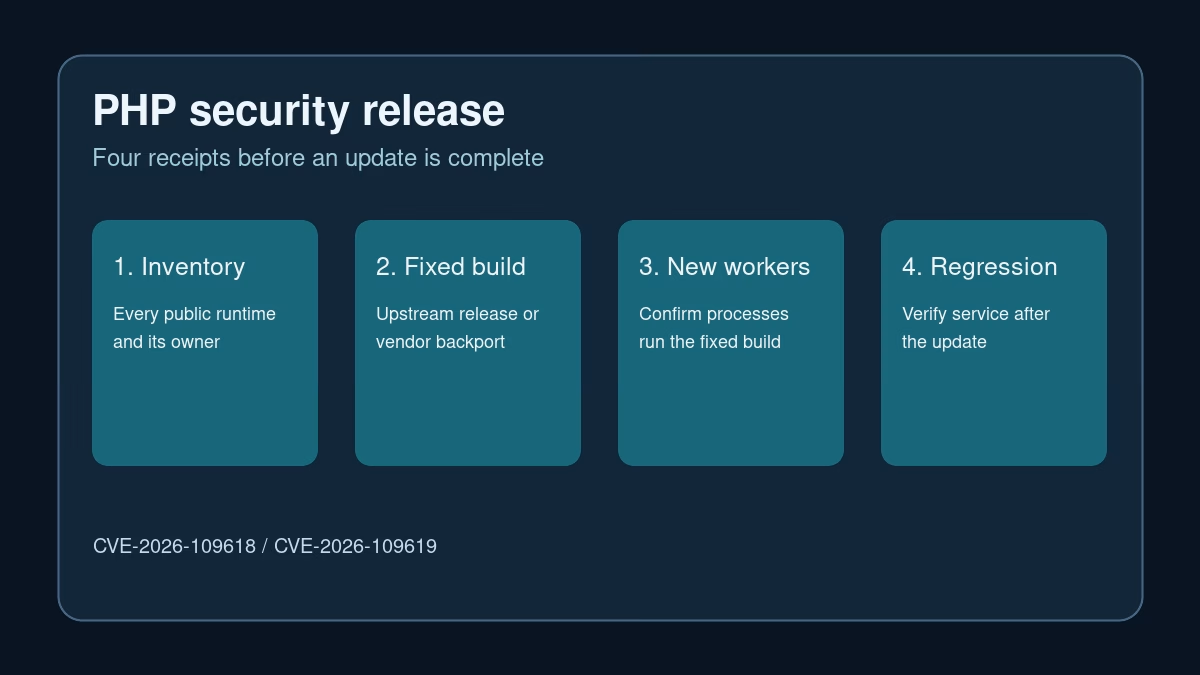
A practical response has four receipts: the approved fixed package or vendor backport, a deployment record for every in-scope environment, evidence that workers were restarted into the fixed build, and a regression check of the application. Prioritize public services and shared hosting environments where one neglected runtime can serve several applications. If a fix cannot be applied promptly, CERT-EU recommends considering isolation of internet-facing applications until a patch is installed and verified.
The last step is to retain the inventory. This emergency exposes a broader weakness if no one can answer which vendor, team or partner controls each PHP runtime. The same ownership map will make the next security release faster and less dependent on hurried manual discovery.
Different deployments need different evidence
For a team operating its own virtual machines, the evidence chain is comparatively direct. Identify the operating-system package and the web server or PHP-FPM service that invokes it. Check the distribution’s security advisory, install the fixed package, restart the relevant service and verify the process that now serves requests. A package-manager success message records an installation; it does not tell you whether every long-lived worker was replaced.
Containers introduce another layer. Updating a base image or Dockerfile is only the first step. The application image must be rebuilt, deployed to each environment and observed running at the new digest. Old replicas can remain active during a rolling deployment, and rollback automation can restore a vulnerable image if its allowed versions are not changed. Keep the base-image reference, build digest and deployment receipt together.
With shared hosting or a managed platform, the customer may have no permission to inspect the host. In that case, obtain a provider notice identifying the affected service, the fixed package or backport and the time the production runtime changed. A generic assurance that the provider “monitors security” is not a patch receipt. Where possible, confirm the application-facing PHP version through an administrative diagnostic that is not exposed publicly after the check.
Agency-maintained websites and purchased applications deserve their own row. The contract owner should ask the supplier whether PHP is embedded, supplied by the hosting environment or both. A WordPress plugin update, for example, does not itself update the underlying PHP interpreter. Likewise, a cloud platform patch cannot fix an unmanaged container image built and shipped by the customer. The inventory must name the party that can change each layer.
Prioritize without losing the long tail
A sensible first pass begins with public web requests, especially installations whose configuration or execution mode matches the PHP project’s highest-risk description. Follow with customer and employee portals reachable through a VPN or identity gateway, then internal tools. This is a triage order, not a claim that private systems are safe. A compromised account or a network foothold can turn a less exposed runtime into a useful target.
The PHP team identified mod_php as the highest demonstrated risk because an unauthenticated request can trigger one exploit path before application code runs. Other supported web execution modes remain within the advisory’s scope. Teams should avoid interpreting that ordering as permission to postpone PHP-FPM indefinitely. The purpose of prioritization is to move the largest reachable exposure first while keeping a complete remediation queue.
For organizations with many applications, start by correlating three lists: DNS names or load-balancer routes, deployment inventories and package or image inventories. Any route lacking a runtime owner becomes a discovery task. Any PHP installation with no route may still be active for background processing or an internal endpoint. These lists will disagree; the disagreements are useful because they identify blind spots before an attacker does.
The two CVEs have different failure mechanisms, so copying one configuration workaround across an estate would be particularly fragile. The PHP advisory describes narrow temporary measures and their limits. Some require a worker restart, and some only block confirmed exploit paths. A change record should state whether a system is fixed, temporarily exposed with a compensating measure, or isolated. It should never label a mitigation as a complete patch.
Make the verification repeatable
The most useful completion record is small enough to reproduce. For each application, preserve its URL or internal service identifier, runtime owner, execution mode, package or image version, vendor advisory where a backport is used, deployment time, restart evidence and an application health result. Keep security-sensitive inventories private. The public-facing conclusion can be a count of verified, pending and isolated systems without exposing hostnames or versions that would help attackers.
Test the service after updating. PHP version changes can reveal application incompatibilities, especially where a legacy framework depends on unsupported behavior. A prearranged smoke test should cover login, a normal read operation, a write operation and any critical file-upload or payment path. This is not a reason to defer a critical fix indefinitely; it is a reason to know the failure path before patch night.
Do not close the incident solely because vulnerability scanning reports a fixed version. Scanners may misread backported distribution packages or miss a second PHP installation in another image or path. Conversely, a runtime check from a command-line shell may inspect a different interpreter than the one serving HTTP requests. Reconcile scan findings against package provenance and the application-serving process.
The vendor chain can make this difficult in Latin America, where a customer may rely on a regional reseller, local integrator, hosting provider and global software publisher for one business service. The operational remedy is a clear evidence request to the party with change authority. Ask what was changed, where, when, how the running version was checked and who owns an exception. That question is more useful than asking every supplier for a broad statement that its products are secure.
Turn emergency discovery into a standing control
After the immediate patch, review why any runtime was hard to find. Was it outside the asset register? Did a contractor own it without an internal service owner? Was a production container built from an old image? Did a managed provider give no version-level evidence? Each answer points to a maintenance control that can be improved before the next advisory.
The PHP security release is urgent because the fixed versions already exist and the consequences can be severe. It is also revealing because the hardest part may be establishing who operates every copy of the runtime. Organizations that can produce four receipts for each service—inventory, fixed build, new workers and a healthy application—will know what they actually remediated. Everyone else is still working from assumptions.