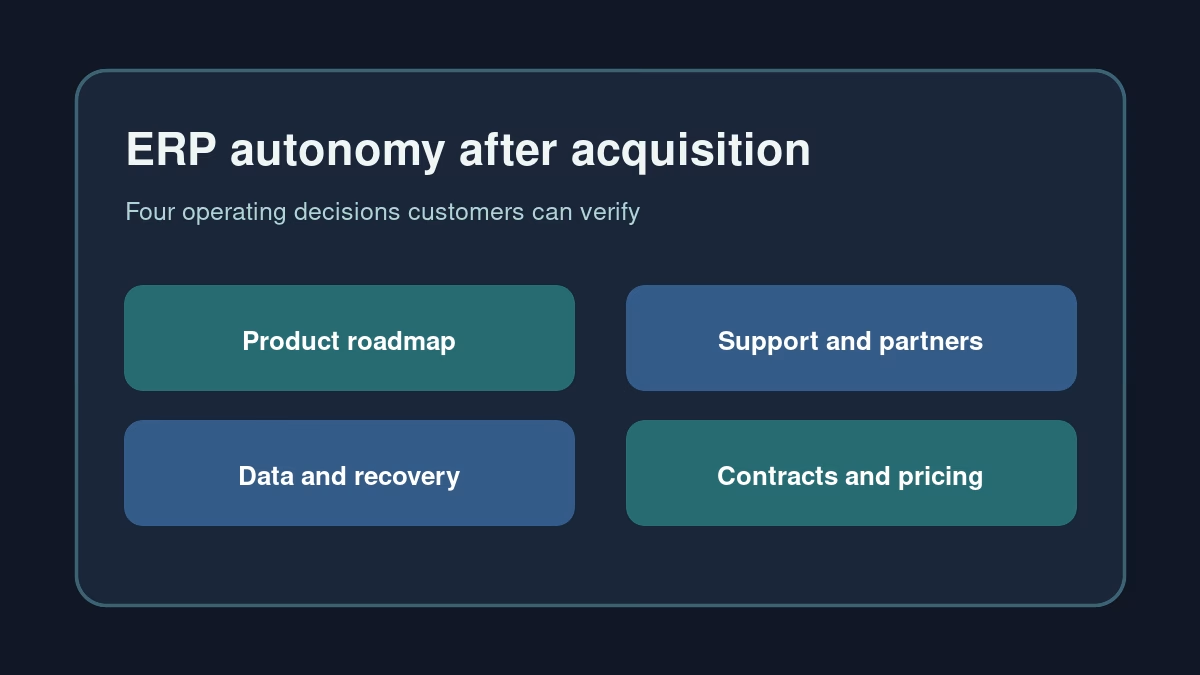
Vela LatAm’s acquisition of Axoft Argentina is more than the purchase of a familiar ERP brand. It is the group’s first entry into Argentina through a company whose software sits inside everyday accounting, payroll, retail and management workflows. The transaction also offers a clear test of an acquisition model that promises local operating autonomy while adding the resources of a larger software group.
The buyer announced the completed acquisition on October 2. Axoft develops Tango Software and will keep its brand, team, leadership and market strategy, according to Vela LatAm. The buyer did not disclose a price. Counsel for the parties says the purchase covered 100% of Axoft Argentina’s equity. Those are verified transaction facts; the eventual effect on customers remains to be demonstrated.
For technology leaders, the useful question is what “independent operation” means once product roadmaps, support budgets and acquisition economics meet. ERP is difficult to replace because it encodes years of processes, integrations, tax rules and user habits. A change in ownership deserves a practical continuity review, even when the buyer promises to preserve the existing organization.
Why this asset matters
Axoft says it serves more than 79,800 business customers through over 200 sales and service centers, and has trained more than 110,000 people. It has more than 300 employees. These are company-reported figures, useful for describing its scale rather than audited measures of active deployments or customer satisfaction. The company was founded in Buenos Aires in 1988 and serves businesses ranging from accounting practices and retailers to larger enterprises. Its own product site describes the Tango management line and related offerings.
That footprint gives the acquisition a different character from buying a narrow startup product. Tango is part of a working ecosystem: accountants, implementation partners, internal administrators and software integrations depend on it. The buyer acquires the relationships and operational knowledge around the product as well as its code. Preserving that network may be as important as financing new features.
Vela LatAm describes itself as a long-term owner of specialized software businesses. Its own acquisition announcement says Axoft will continue with its existing management and commercial strategy. Its published acquisition model says acquired businesses retain their identity and autonomy. The buyer is an operating group of Constellation Software. Its Argentine entry follows acquisitions in Brazil, Chile and Colombia; the announcement says it had completed more than 25 acquisitions in those countries before Axoft. The strategic pattern is clear, but the transaction alone does not prove that every local product decision will remain local.
Autonomy has several layers
“Autonomy” can describe ownership of very different decisions. The brand may remain unchanged while security standards, capital allocation, pricing, staffing or infrastructure architecture shift. Customers should ask which decisions Axoft can make directly, which require group approval, and how that division will be communicated when it affects contracts or service.
The first layer is the product roadmap. Does the local team still prioritize Argentine statutory changes, payroll requirements and accounting integrations? Can it defer a group-wide platform initiative when a local compliance change is urgent? A public commitment to maintain the brand does not answer those questions. Roadmap continuity should be judged by delivered releases and transparent dates.
The second layer is support. The network of service centers is an asset only if customers can still reach people who know their deployment and can escalate defects to engineers. A larger group may provide better engineering methods, security resources and purchasing power. It may also introduce new approval paths. Neither result follows automatically from the deal; service-level evidence over the next few quarters will tell customers more than the acquisition announcement.
The third layer is data and infrastructure. Customers should identify where hosted components, backups, telemetry and support copies reside now, and whether those boundaries change. If data handling or subcontractors change, the relevant contract, retention, incident-notification and export terms should be updated before migration. These questions are ordinary supplier governance, not an allegation that the buyer intends to move data.
The fourth layer is commercial control. Terms, licenses, renewal dates and partner incentives are part of a long-lived ERP deployment. A promise of operational independence should eventually be visible in renewal proposals and partner relationships. Buyers can compare each new offer with their existing rights and the actual cost of switching or integration.
What to check before the next renewal
An ERP owner need not start a replacement project because shareholders changed. It should use the next account review to establish a baseline. Ask for the supported product versions, update cadence, end-of-support dates and a named escalation owner. Record which local statutory or regulatory functions are on the roadmap and how urgent changes are prioritized. Check whether integrations rely on documented interfaces or on brittle customizations known only to one partner.
Request a tested export path for core records and configurations. An export is useful only if it includes enough context to reconstruct ledgers, masters, permissions and audit history. A successful file download is not proof of portability. An organization can test a small restore or migration exercise and document what still requires proprietary tools or partner assistance.
Review backup and recovery responsibilities as well. For hosted services, ask who performs backups, who holds encryption keys, which recovery times are contractual, and when a restore was last exercised. For on-premises installations, clarify where the vendor’s responsibility ends and the customer’s begins. Ownership changes are a sensible trigger to refresh this map because support teams and infrastructure vendors may evolve independently of the product name.
Finally, keep an evidence log over two or three release cycles: promised versus delivered updates, severity-one response times, partner escalations and changes to contract terms. That is a fairer way to assess the new owner than either assuming a global group will fix everything or assuming consolidation must degrade service.
The regional signal
The acquisition brings an established Argentine ERP vendor into a group that buys and develops specialized software across Latin America. Vela LatAm says its strategy is to retain acquired companies’ brands and leadership while adding investment, shared practices and long-term ownership. Its Axoft announcement states that the transaction is its first step in Argentina. The legal advisers’ transaction account independently confirms the completed acquisition and continued independent operation.
For founders, this is evidence that mature local software firms with embedded customer ecosystems can attract regional buyers. For CIOs, it is a reminder that supplier concentration and supplier stability can rise together. Long-term capital may support a product through changes its standalone owner could not easily finance, while a broader owner creates a new dependency above the local vendor.
No public transaction value was disclosed by Vela LatAm, and the available first-party materials do not establish future pricing, investment amounts, product changes or customer outcomes. Those unknowns should remain unknown in any investment or procurement decision. Constellation’s annual information form describes its decentralized management structure, but that corporate policy is not an Axoft-specific service guarantee. The immediate facts are ownership, stated continuity and a substantial local customer network.
The next test is operational. If Axoft keeps delivering Argentine requirements, sustains its partner network, improves reliability and preserves clear customer control over data and contracts, the promised autonomy will have substance. If those measures weaken, retaining the Tango name will offer little protection. Customers can start measuring now, using the systems and agreements they already have.