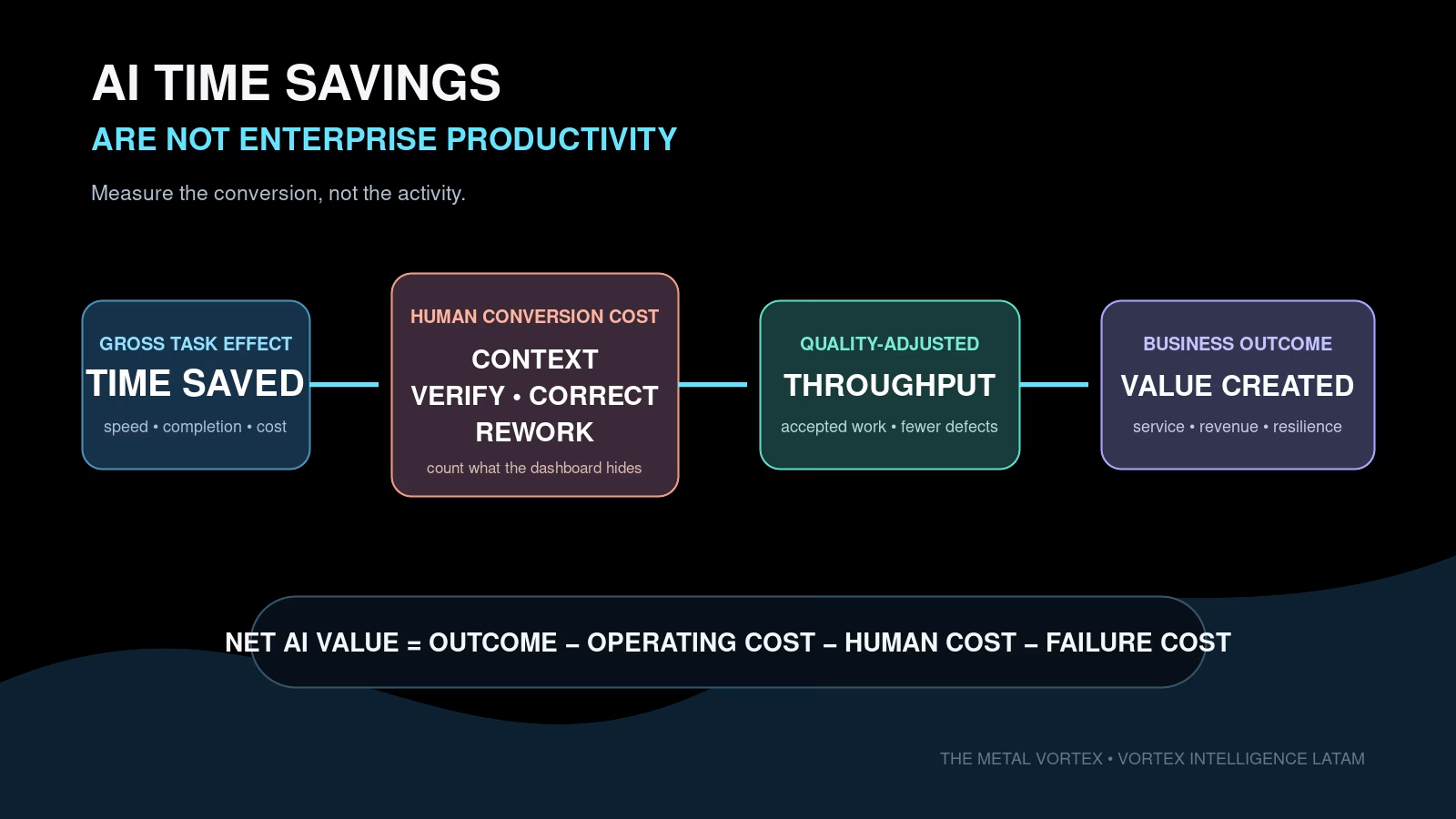
Workers can finish individual tasks faster while the organization absorbs the gain as verification, rework and coordination. Latin American leaders need a measurement system that follows AI output all the way to a business result.
The most dangerous AI dashboard is the one that proves adoption and quietly assumes impact. Licenses are active. Prompts are rising. Employees report saving time. None of those facts establishes that the organization is producing more, producing better work or serving customers more effectively.
New workplace evidence makes that distinction harder to ignore. Glean’s Work AI Index 2026 reports that 75% of surveyed digital workers say AI makes them more productive, while only 13% say their organization is performing significantly better because of it. The same survey estimates that workers spend 6.4 hours a week supplying context, supervising output, debugging mistakes and cleaning up AI-generated work. Glean Work AI Index 2026.
The headline is provocative, but its boundary matters. Glean surveyed 6,000 full-time digital workers in the United States, United Kingdom and Australia. The data are self-reported, the sample skews toward digitally intensive work, and the institute is backed by an enterprise AI vendor. This is not a measured Latin American productivity rate.
It is still a useful warning because independent research points in the same direction: task-level time savings do not automatically become organization-level output.
A saved hour has no predetermined destination
A large randomized field experiment provides a cleaner view of the gap. Researchers studied 7,137 knowledge workers across 66 firms and randomly assigned access to a generative AI tool integrated into email, meetings and writing applications. Among the treated workers who used it during the second half of the six-month experiment, time spent on email fell by two hours a week and after-hours work also declined. Yet the researchers did not detect changes in the quantity or composition of tasks from individual access alone. NBER: Shifting Work Patterns with Generative AI.
An hour can become deeper analysis, faster customer response, more transactions, fewer errors, shorter queues, lower overtime or simply breathing room in an overloaded job. It can also disappear into more meetings, additional low-value output, duplicated work or the effort required to verify the AI itself.
Without an explicit destination, “time saved” is an input metric. It is not a result.
The International Labour Organization’s 2026 review of empirical evidence reaches a compatible conclusion. It finds real but uneven productivity gains across experiments and workplace studies, while worker-reported time savings have not yet translated consistently into higher measured output, earnings or employment. It also emphasizes effects on work organization, coordination, autonomy and job quality. ILO: The impact of GenAI on jobs, productivity and work organization.
The Latin American conversion gap
Latin America should not import a productivity percentage from a survey of three higher-income economies. The region has different occupational structures, levels of informality, connectivity, enterprise software coverage, management practices and access to training.
An Inter-American Development Bank study adapted international task-exposure methods to Chile, Mexico and Peru. The theoretical average exposure to large language models was 32% under one occupational classification and 31% under another. After adjusting for each country’s practical capacity to adopt and implement the technology, those estimates fell to 27% and 23%. IDB: AI and the Increase of Productivity and Labor Inequality in Latin America.
Exposure is not realized productivity, and the IDB study does not measure actual enterprise deployments. Its adjustment is nevertheless important: local operating conditions change how much technical potential can become practical use.
A joint ILO-World Bank study makes the infrastructure boundary more explicit. It estimates that generative AI could improve productivity in 8% to 14% of jobs in Latin America and the Caribbean, but that as many as half of the jobs with augmentation potential—about 17 million—are constrained by gaps in digital access and infrastructure. Those are modeled estimates, not realized gains, but they show why regional productivity cannot be inferred from model capability alone. ILO and World Bank: Generative AI and jobs in Latin America and the Caribbean.
The same conversion problem exists inside a company. A model may be capable of summarizing a credit file, drafting a procurement document or classifying a service case. The organization gains only when the surrounding workflow supplies reliable context, assigns decision rights, catches errors at the right point and moves the result through the next handoff.
Replace the adoption funnel with a productivity ledger
Enterprises need a measurement model that follows one use case from AI activity to business outcome. A compact productivity ledger can do that with four layers.
The first layer is gross task effect. Measure the time, cost and completion rate for the task before and after AI. Use matched work where possible. A self-reported estimate can help with discovery, but it should not be the only evidence.
The second layer is human conversion cost. Count the time spent finding and loading context, checking facts, correcting output, rerunning failed attempts, reconciling tools and repairing downstream problems. Separate productive review required by the risk of the task from avoidable rework caused by weak systems.
The third layer is quality-adjusted throughput. Track accepted work, defect rates, customer corrections, escalations, cycle time and rework after handoff. More drafts are not useful throughput when another team must rewrite them.
The fourth layer is business outcome. Choose the result the workflow exists to create: resolution time, conversion, fraud loss, payment accuracy, recovery time, service availability, revenue, cost per completed case or another observable outcome.
The basic equation is deliberately simple:
Net AI value = business value from quality-adjusted output – AI operating cost – human conversion cost – downstream failure cost.
Not every term needs to be converted into currency on day one. The discipline matters more than false precision. If a team cannot identify the downstream outcome or estimate the review burden, it is not ready to claim a return.
Verification should be designed, not hidden
The Glean survey calls the labor around AI “botsitting.” The label is memorable, but enterprises should divide that work into three different categories.
Necessary judgment is the expert review justified by the consequence of the task. A lawyer validating a contractual claim or an analyst confirming a financial figure is not cleaning up a nuisance; that person is operating a control.
System debt is work the platform should remove: copying the same context into several tools, locating the authoritative version, correcting a broken integration or reconstructing provenance after generation.
Failure demand is work created because an incorrect or low-quality output escaped downstream. It includes customer complaints, incident response, revised filings, repeated tickets and colleagues fixing material they did not create.
Treating all three as one number leads to the wrong intervention. Necessary judgment needs capacity, training and decision authority. System debt needs better context architecture and integration. Failure demand needs stronger release gates, testing and root-cause correction.
The objective is not zero supervision. It is to put deliberate review where consequences require it and eliminate accidental review everywhere else.
Run a four-week conversion test
Before expanding an AI program, choose one recurring workflow and run a bounded test.
For the first week, record the baseline: incoming volume, completed cases, cycle time, error and rework rates, waiting time, overtime and customer or business outcome. Do not begin with a model metric.
For the next two weeks, introduce AI to a defined group while keeping a comparable baseline group or historical benchmark. Instrument prompt and model cost, but also record context preparation, verification, corrections, abandoned attempts and downstream returns.
In the fourth week, compare quality-adjusted throughput and the business outcome. Interview both the AI users and the people receiving their work. The downstream team often sees defects that the producer’s productivity dashboard misses.
Then make one of four decisions:
- expand because net throughput and the target outcome improved;
- redesign because gross time fell but conversion costs absorbed the gain;
- narrow the use case because AI helps only a subset of tasks or less-experienced workers;
- stop because quality, risk or total cost worsened.
What leaders should ask now
Every AI steering review should be able to answer five questions:
1. Which business outcome should this use case change? 2. Where does the saved time go after the task is completed? 3. How much human work is required before and after the AI output? 4. Is quality measured by the team producing the work and the team receiving it? 5. What evidence would cause us to redesign, narrow or stop the deployment?
The productivity debate is not resolved by declaring AI transformative or disappointing. Both can be true in different tasks, roles and organizations. The empirical record increasingly shows that AI can save individual time while leaving the larger system almost unchanged.
For Latin American enterprises, the opportunity is not to chase the highest adoption rate. It is to become unusually good at converting technical capability into reliable work under local conditions. That requires measuring the whole loop: context, generation, judgment, handoff and outcome.
If the dashboard ends at the prompt, the productivity claim begins too early.
Sources
- Glean Work AI Index 2026
- NBER: Shifting Work Patterns with Generative AI
- International Labour Organization: The impact of GenAI on jobs, productivity and work organization
- Inter-American Development Bank: AI and the Increase of Productivity and Labor Inequality in Latin America
- ILO and World Bank: Generative AI and jobs in Latin America and the Caribbean